
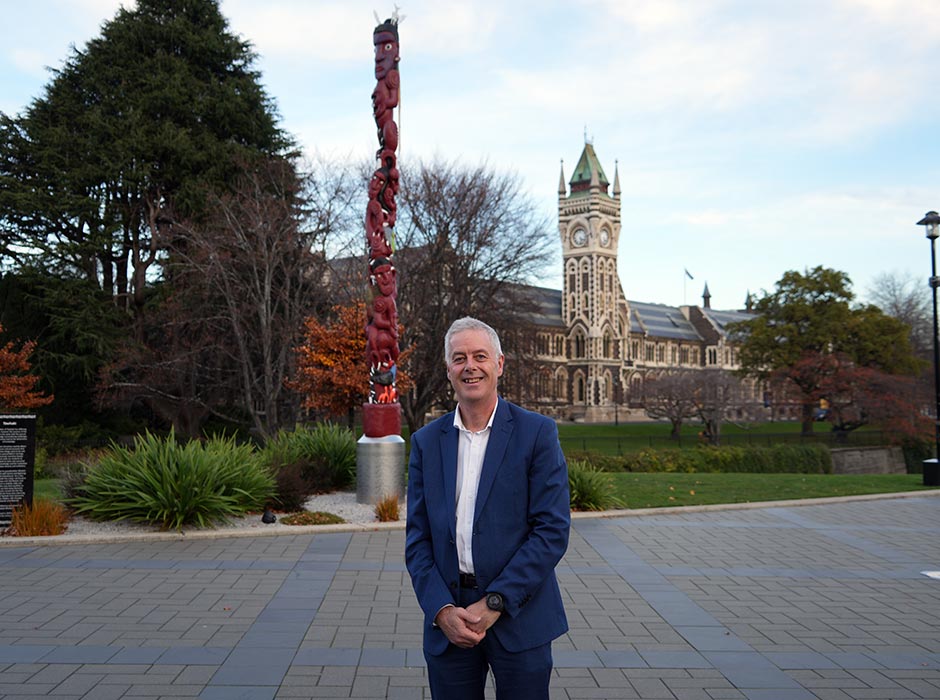
Deputy Vice-Chancellor (DVC) Research and Enterprise Professor Richard Blaikie retires at the end of May, as Otago’s longest-serving DVC.
As Otago’s longest-serving Deputy Vice-Chancellor, and newest Emeritus Professor, Richard Blaikie has many a fond memory to look back on. On the eve of his retirement, Sandra French caught up with Richard for a trip down memory lane, looking back at his journey to, and time at, Otago.
He aha te mea nui o te ao? He tāngata, he tāngata, he tāngata.
What is the most important thing in the world? It is people, it is people, it is people.
The people he’s met have been the best part of Professor Richard Blaikie’s time at Otago, be it the Dalai Lama or staff members and students he has crossed paths with.
Shining a light on the achievements of Otago’s staff and students has been the hallmark of his leadership as Deputy Vice-Chancellor Research and Enterprise.
And when asked if that is the legacy he leaves behind, he says, “but isn't that what everyone should do? It's not rocket science.”
“One of the things I always say is my first job is to get out of the way,” Richard says.
“And if getting out of the way is the right thing to let people succeed and flourish, that's number one. If there needs to be guidance and assistance, absolutely. But it's about supporting, not directing.”
Otago has been an enduring presence in Richard’s life “for as long as I can remember”.
“Both my parents had good, long careers with the University, my father as a lecturer in the School of Surveying and my mother working in student administration.”
Coming to Otago felt like somewhat of a family tradition, Richard says.
“My parents were wonderful and supported us in whatever path we chose.
“Through investigating a few different options, my path ended up in the University as a student. Initially, in engineering intermediate, but then, the physics courses were so interesting and so wonderful that I decided to pursue physics and went on to get an honours degree.”
And even though he found physics “fundamentally interesting”, a life of academia and research wasn’t always destined.
While he pondered his options in the late ’80s, Richard worked part-time at Mornington Countdown (now Woolworths), a job he had since he was in school, and one his wife worked at too.
“I did it Thursdays and Saturdays. Stacking shelves, checkout operator, trolley pushing, you name it, I did it. I was the shift manager on Saturdays and got to be my girlfriend’s boss on those shifts.
“The job was great. Once or twice a week I would have to disconnect from really fascinating, interesting academic study matters and just connect with real people about literally the price of potatoes.”
As he neared the end of his honour’s degree, he was primarily thinking of vocational career options.
“In my final year, my dream job would have been working overseas for a big company like IBM at their Yorktown Heights research laboratory.”
An IBM New Zealand recruitment seminar on campus proved to be “deflating” when the only roles available were sales and marketing. And tech-related jobs in New Zealand were few and far between in those days, Richard says.
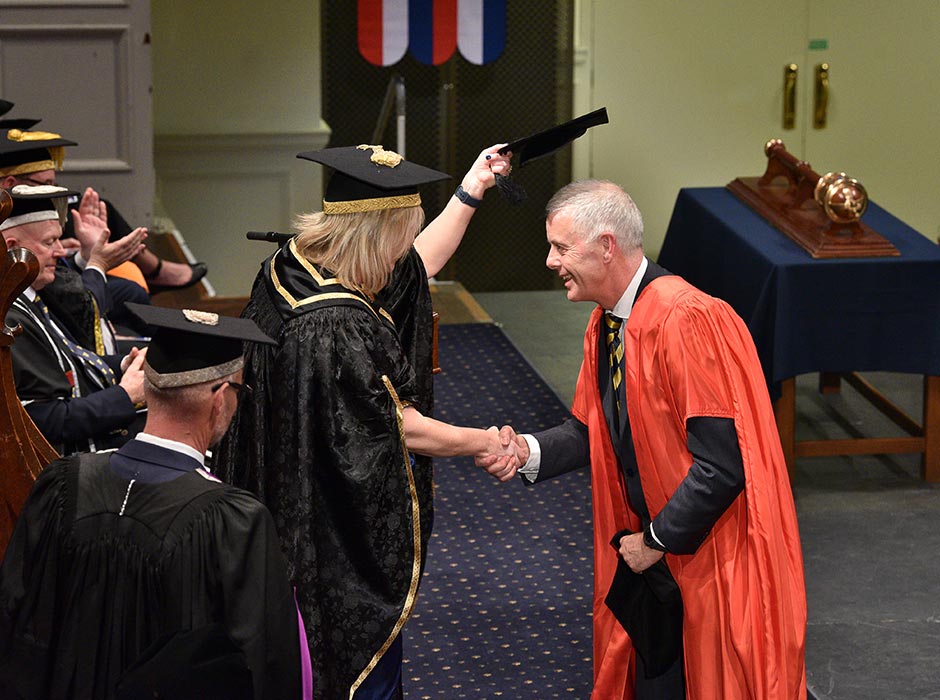
Deputy Vice-Chancellor Research and Enterprise Professor Richard Blaikie receives his Honorary Doctor of Science from Otago Chancellor Trish Oakley. Photo: McRobie Studios Dunedin.
So to “keep all options open”, he considered postgraduate study.
“Applying to American universities involved a lot of paperwork and exams. With the scholarship application I could complete a single form, provide my academic transcript, and I could literally tick as many boxes as I liked on the top of that form.”
One of the boxes he ticked changed the trajectory of his life and his career. In 1988, Richard found out he had received the one Rutherford Memorial Scholarship awarded throughout the Commonwealth each year.
“I was over the moon. It was life-changing realising I now had the privilege to be able to go overseas and study for three or four years supported by the Scholarship.”
The award enabled him to study microelectronics at the Cavendish Laboratory in Cambridge University, where he gained his PhD in 1992.
“Cambridge and Oxford were the two universities I considered. Otago’s Department of Physics had very strong research links with Oxford, so I went to Cambridge. I really wanted to do something different.
“I had this wonderful opportunity to look at a comprehensive list of available projects and consider what sounded the coolest and most interesting, which is why I chose microelectronics.”
It was a fortuitous choice for Richard as Hitachi, a Japanese conglomerate at the forefront of technology, sponsored the lab and helped build a new laboratory.
“I got to work with Japanese scientists from industry. It was in a way like my early ambition to work for a company like IBM.
“That also meant it was seamless for me to be offered a one-year visiting scientist position at the same lab working on projects similar to my PhD.”
Bereavements in the family amplified the call home, and in 1993, after five years at Cambridge, Richard and his wife moved back to Aotearoa, settling down in Christchurch.
A fruitful career at the University of Canterbury followed, with Richard moving from a short-term postdoctoral position to a member of faculty, to Professor.
The 2011 Christchurch earthquakes had already prompted discussions of a move, when Otago came calling.
Professor Harlene Hayne, then the incoming Vice-Chancellor of Otago, suggested that Richard apply for the position of Deputy Vice-Chancellor (Research and Enterprise).
“I knew Harlene from our time on the Marsden Fund Council and when she suggested I apply, my first reaction was ‘no way’.
“I'd never been a head of department, and I never envisaged moving up in my academic career like that, even though I had some of the requisite skills through my involvement with the MacDiarmid Institute.
“I really didn’t want to pull myself away from research and take on a senior administrative role. But it was the requirement that senior academic leaders at Otago continue academic activities that convinced me.”
The rest, as they say, is history.
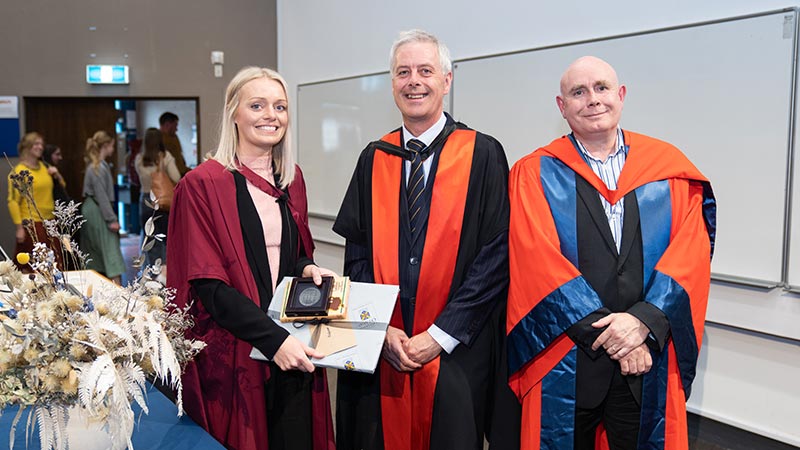
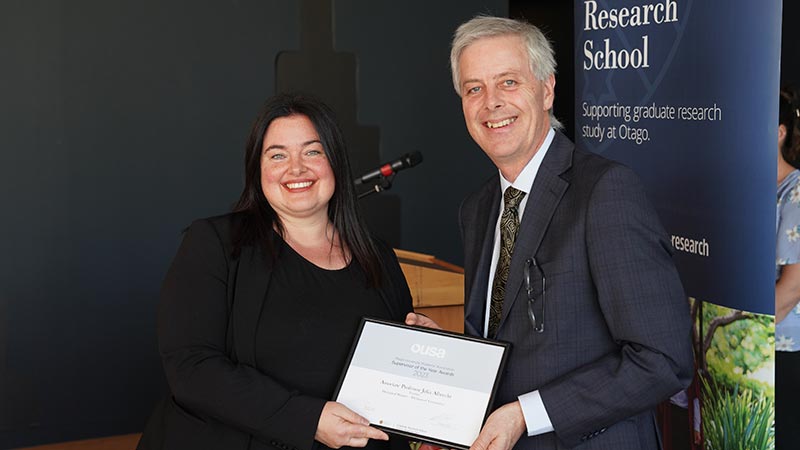
Since he took on the role of DVC in 2011, Otago has been a source of many highlights and accolades, but the most prized amongst those are “people-related”.
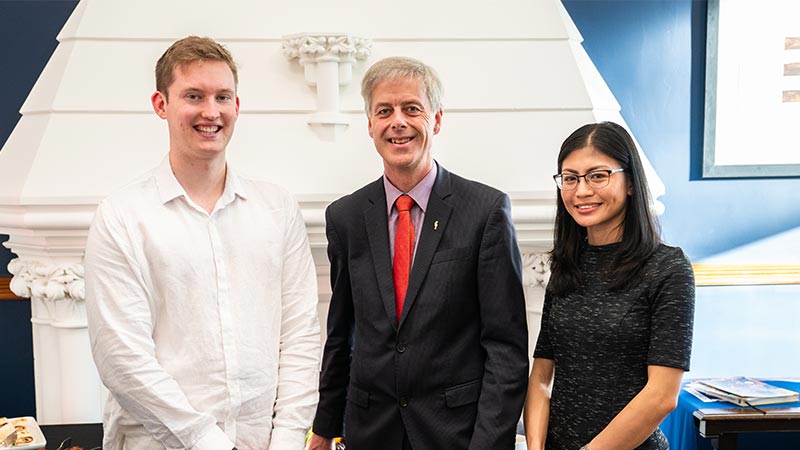
“Every year, going to the Royal Society research honours, the Prime Minister's Science Awards or the L'Oreal-UNESCO For Women in Science awards, seeing Otago people receive awards, and somehow thinking that, yes, it reflects well on Otago, but also that what you do makes a difference to help provide the environment where people can succeed.”
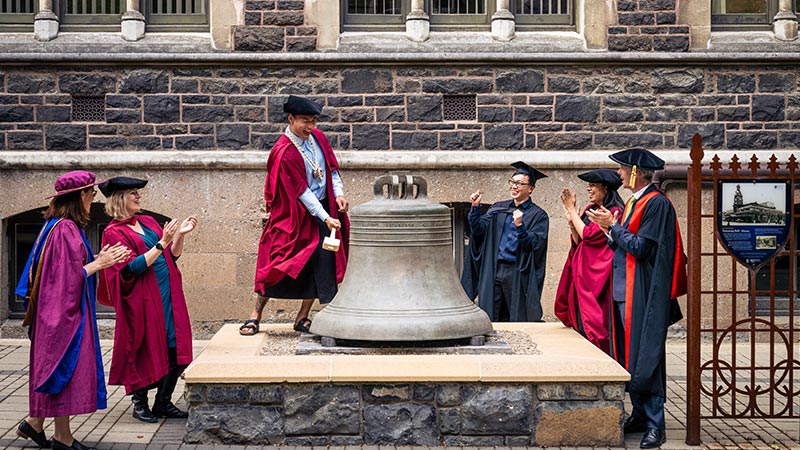
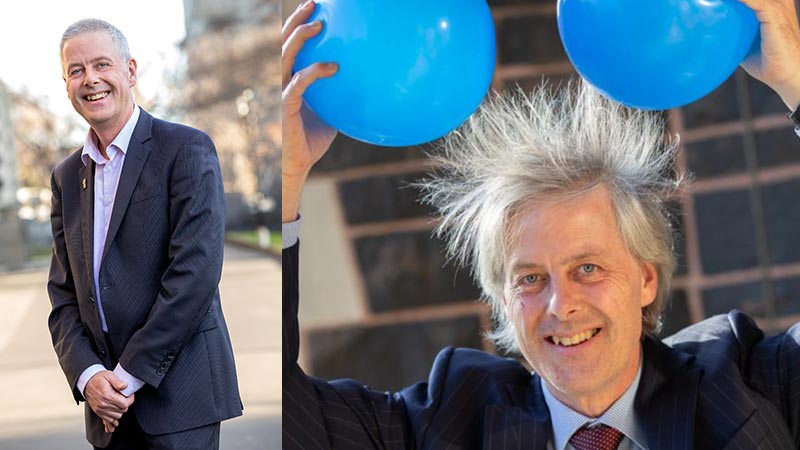
Richard will be long remembered for many other contributions too, from the doctoral students ringing the bell, to renouncing haircuts during the Covid lockdowns and even the little-known anecdote of playing amateur firefighter and saving the Clocktower.
“While it didn’t quite make the news, I helped stop an electrical fire in the office next to mine. We managed to turn the power off and get a fire extinguisher to put it out.
“Everything was okay in the end, but it was that moment of thinking, oh, if this thing starts burning a bit more, it could burn the Clocktower down.”
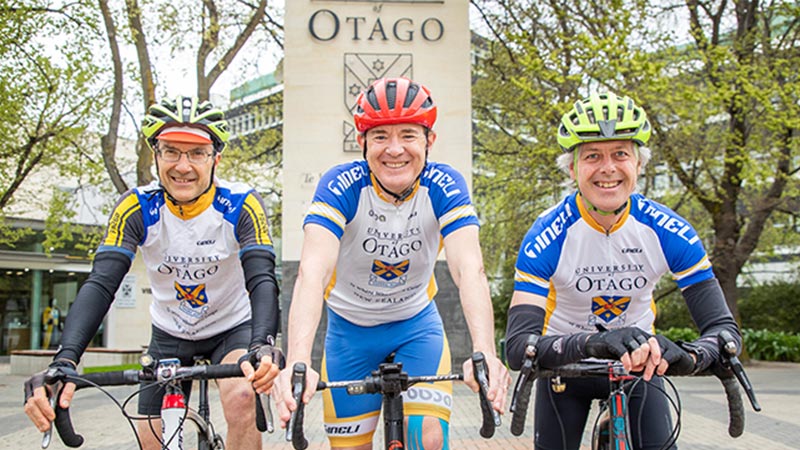
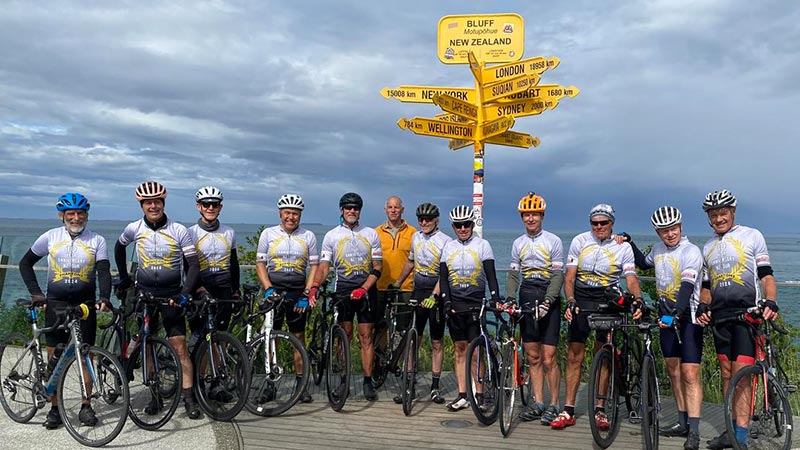
Retirement will allow Richard to spend more time on his other passion, cycling, through which he has also supported charitable endeavours.
Alongside cycling enthusiasts from the social cycling group the Phantoms, Richard has helped raise funds for Pūtea Tautoko Student Relief Fund and Otago Southland Rescue Helicopter Trust.
Cycling will also be his “selfish activity” when he visits his sister in Europe later this year.
“I'm really looking forward to cycling the mountains of Switzerland and northern Italy.”
Family time and rest are also part of his plans post-retirement, with a family holiday to the Gold Coast planned, “supporting the return of direct flights from Dunedin to Australia”.
Otago features in his plans too, as Richard still has “research curiosity” to satisfy.
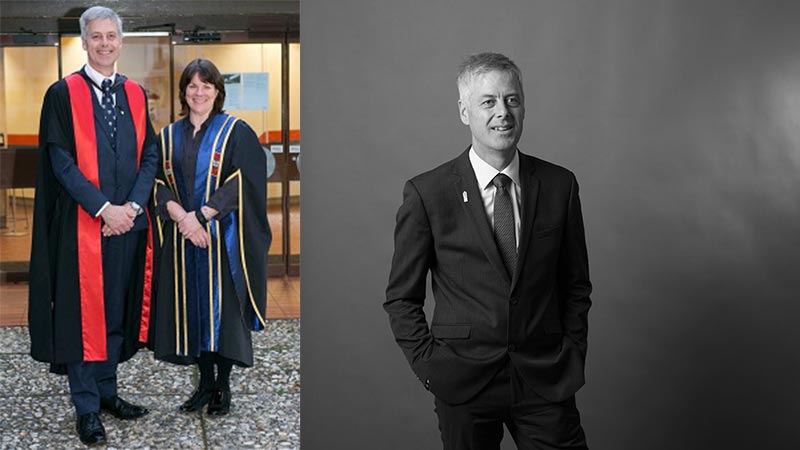
He was recently presented with an Honorary Doctor of Science and has also been made an Emeritus Professor, acknowledging his contributions to science and Otago, and allowing him to “stay connected to academic activities”.
“I'm just so thrilled about becoming an Emeritus Professor and the honorary doctorate is such an amazing honour.
“I can continue to work in an advisory capacity or take on some project work. But really interestingly, in the past couple of weeks, I've come up with some ideas I want to explore in my fundamental research area of nano optics.
“I'm quite encouraged that I'm either on the verge of a little breakthrough or I'm on the verge of discovering that one of my dead-end avenues of research is still a dead-end.”
Richard is also keen to explore opportunities to lend his expertise further afield, he says.
“I will probably take on or look for opportunities in advisory or governance, particularly in the tech space.
“I see huge opportunities for the growth of high-tech industries in Aotearoa, to increase productivity and prosperity in this country without adding to emissions and our carbon footprint.”
All said and done, the Professor, while retired, has not quite left the campus.
“I'll probably still hang out here now and then and go for coffee. I won't have an office here, but I've got some physics lab space I can use, or I'll probably work in the library.”
Looking back at his career, Richard values all the connections he has made.
He recalls his time as a Fulbright Fellow at the Massachusetts Institute of Technology, where one of the post-docs he interacted with is now the head of research at IBM.
“You work with people, and they go on and do amazing things, and you can say, you know, I know that person.
“It's just amazing to get to the end of a career and think of the range of connections that you create by having what you hope is a reasonably ordinary and successful academic life.”
But maybe it wasn’t so ordinary, and maybe academia was his destiny after all. His colleagues at Mornington Countdown sure had an inkling about the “geeky physics student” they worked with.
“Do you know what my nickname was back then?” Richard asks with a smile.
“They called me the Prof.”
~ Kōrero by Sandra French, Adviser, Internal Communications.