
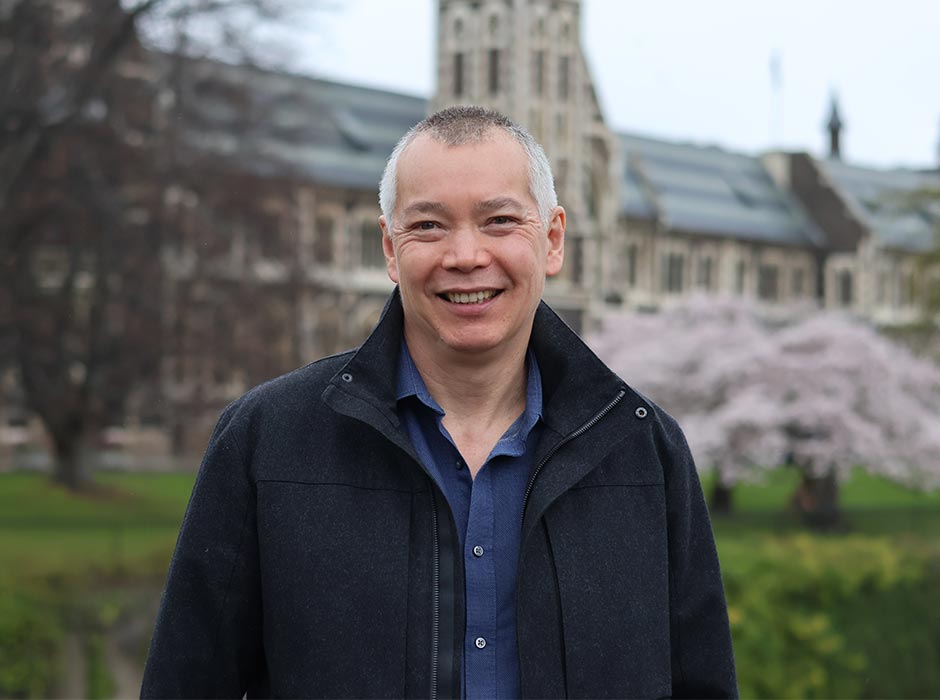
Professor Michael Jack, Co-Director of the Otago Energy Research Centre (OERC), prepares for the 20th annual OERC symposium – Powering prosperity: An energy transition for people, business and environment.
If you’re interested in more affordable and sustainable energy on a national, regional or even personal scale, there will be something for you at this year’s Otago Energy Research Centre (OERC) Symposium, to be held at the Otago Business School and online on 26 and 27 November.
This year’s symposium, the twentieth, is themed Powering prosperity: An energy transition for people, business and environment.
OERC is co-directed by Associate Professor Sean Connelly from Geography and Professor Michael Jack from Physics. Michael says the symposium will showcase topics across finance, sustainability and physical and social science, providing holistic insights into the energy we use for our economic and social needs.
“Energy is quite multi-disciplinary, and having people coming in from their specialities and presenting in the same forum leads to a very rich experience,” he says.
As a physicist, Michael looks forward to learning from his colleagues in the social sciences.
“I’m interested in hearing about energy hardship research for example, which is completely outside my realm of normal research.”
Michael, who left a career in quantum mechanics to focus on sustainable energy, says planning for the future at a national level is key to getting the outcomes we want.
“I do a lot of modelling of energy systems, which involves thinking about what our electricity systems are going to look like in the future, and trying to ensure that they’re as low cost, efficient and environmentally beneficial as possible.”
This theme is taken up by one of this year’s keynote speakers Dr Sam Elder, Founder and Director of Climate Navigator, who will be making the case for developing a collective vision of what we want for our future energy system.
The symposium will also dig into thorny issues and potential futures.
A second keynote speaker, Dr Thomas Longden from Western Sydney University, will explore growing inequities related to the preferential uptake of new technologies (such as solar PV and batteries) by more affluent households.
“Every year we have a range of people who are interested in energy attend the symposium. People keep coming back!”
Answering philosophical questions about energy access is important – as is rethinking our approach to infrastructure.
“If we end up building a larger system and increasing the size of the electricity lines, that increases cost for consumers,” Michael says.
It would be more efficient to move from a model of centralised energy generation to a future where we have more distributed energy resources, more controllable demand, and greater focus on renewables.
Dr Andrew Sykes, Technical Director Future Grid from Transpower New Zealand, will present results showing how a more geographically and technologically diverse electricity system can deliver more affordable, reliable, and sustainable outcomes.
“Renewables are the cheapest form of future electricity generation, and in New Zealand we’re quite privileged in having 85 per cent renewable energy already,” Michael says.
“We have abundant untapped wind both onshore and offshore, and commercially and for individuals, solar makes sense economically now.”
Hot topics such as hydrogen and AI data centres will also be covered.
Michael says hydrogen could help us make the most of solar in the future, while there’s an opportunity for New Zealand to build more data centres – if we have the right strategic planning and long-term, cross-party thinking.
Michael hopes to see people from industry, local government, community groups and academia at the conference – along with interested individuals.
“Every year we have a range of people who are interested in energy attend the symposium. People keep coming back!”
20th OERC Symposium
Registrations are now open for Powering prosperity: An energy transition for people, business and environment, which will be held on 26 and 27 November.
More about the symposium