
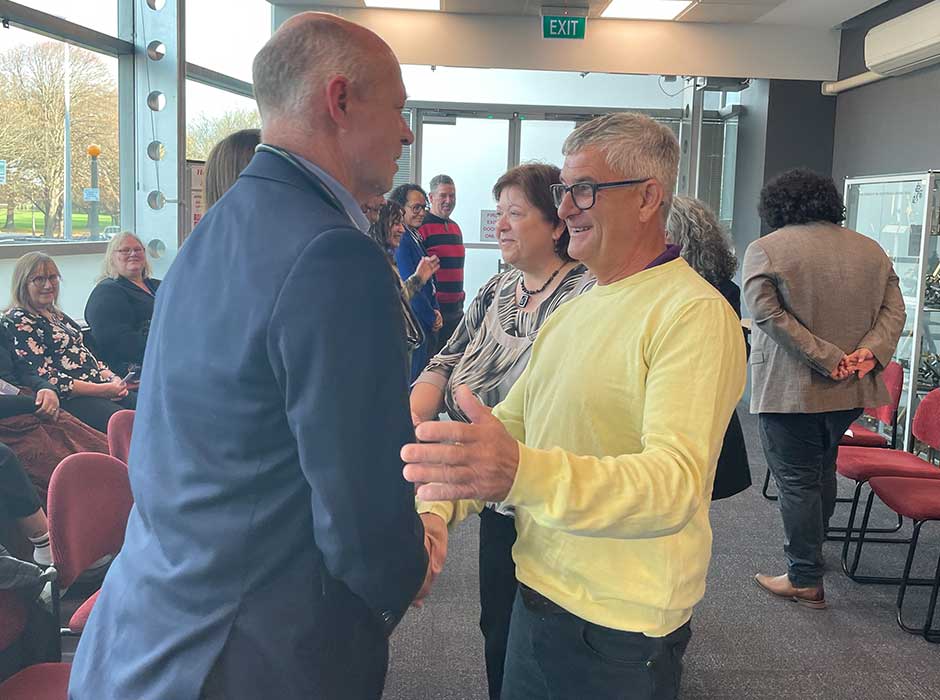
Ōtautahi campus Dean Professor Lutz Beckert, left, welcomes Associate Professor Stewart Sutherland (ANU).
Otago’s Faculty of Medicine – Christchurch Ōtautahi recently welcomed four Indigenous health academics from the Australian National University (ANU) in Canberra, marking an important step in developing a long-term partnership focused on Indigenous health education, social accountability, and academic excellence.
The ANU delegation, Associate Professor Stewart Sutherland (Head of ANU’s Indigenous Health team), Dr Tjanara Goreng (ANU Indigenous Health lecturer), Professor Paul Fitzgerald (ANU’s Director of the School of Medicine and Psychology) and Associate Professor Krisztina Valter-Kocsi (Associate Director of HDR, ANU Medical School), spent a day on campus, providing an opportunity to share knowledge, strengthen relationships, and explore future Indigenous teaching and research collaboration between the two universities.
The visit built on ongoing discussions from Otago and ANU’s Indigenous health leaders. Together, the group is working towards establishing a sustainable and reciprocal partnership between the universities' medical programmes.
During their visit the ANU academics met with key campus staff including Head of the Department of Māori Indigenous Health Innovation (MIHI) Dr Maira Patu, campus Dean Professor Lutz Beckert as well as former Dean and now Head of Otago’s Faculty of Medicine Professor Suzanne Pitama.
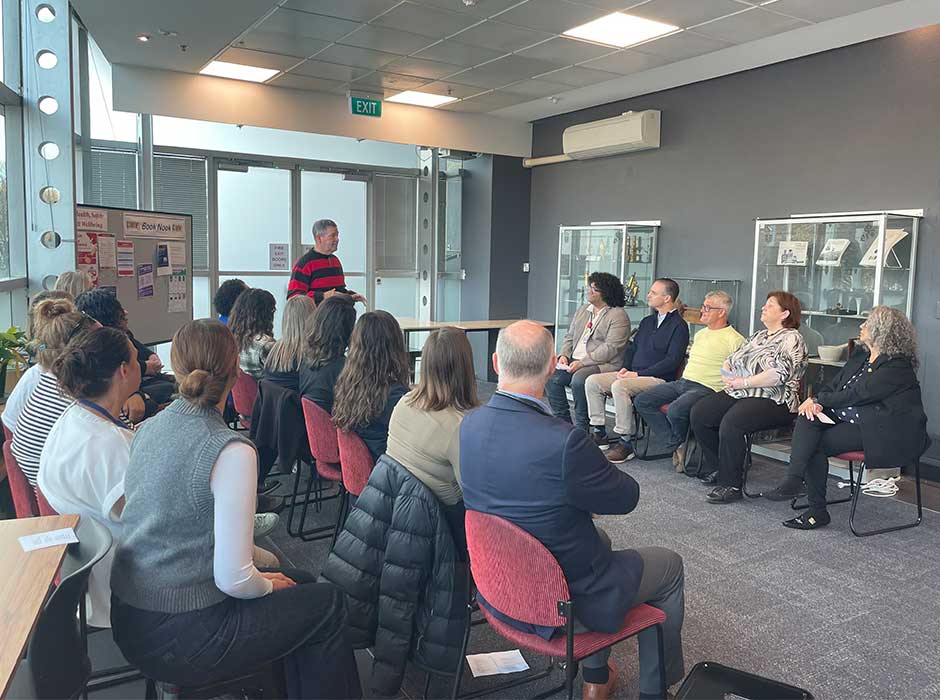
Australian National University (ANU) Indigenous Health delegates being welcomed onto the Faculty of Medicine - Christchurch Ōtautahi campus. Te Marino Lenihan - Kaitohutohu Rangahau Māori, Pou Tiaki (striped top standing.) delivers the mihi whakatau to (seated from l-r); Tamati Te Kahu (Kaiwhakahaere, Otago's Department of Medicine), Professor Paul Fitzgerald (ANU), Associate Professor Stewart Sutherland (ANU), Associate Professor Krisztina Valter-Kocsi (ANU) and Dr Tjanara Goreng (ANU).
The group was formally welcomed with a mihi whakatau led by Te Marino Lenihan, Pou Tiaki for the Ōtautahi campus, before meeting to discuss Indigenous teaching methodologies, assessment practices, and approaches to meaningful community engagement. The ANU delegation also toured the new campus research building Wai-Ora, which opens in mid-September.
The visitors also attended Tamariki Ora Day, a longstanding collaboration between MIHI, the Department of Paediatrics, and Dr Anthony Bedggood and his team from the Family Eye Centre.
Tamariki Ora Day sees fifth-year medical students visit Te Kura Kaupapa Māori Te Whānau Tahi school to carry out health assessments on more than 180 tamariki, delivering care and health promotion in te reo Māori. The programme provides students with valuable clinical experience while supporting the health and wellbeing of tamariki and whānau.
Maira says the ANU campus visit highlighted the value of sharing Indigenous health education initiatives and learning from one another.
“This is about building a genuine, long-term relationship – one grounded in Indigenous social accountability,” she says.
” Sharing our Tamariki Ora Day and the mahi our students undertake at Te Kura Kaupapa Māori Te Whānau Tahi showcases the hauora Māori teaching mahi developed by Suz and the Ōtautahi team over the past 20 years.
” We’re excited to learn from ANU in return.”
She says the partnership is expected to create opportunities for collaborative medical education research as well as staff and student exchanges in advance of a planned symposium on Indigenous Medical and Health Education in the city later this year. The symposium is expected to coincide with a visit from the University of British Columbia Faculty of Medicine, creating further opportunities for international knowledge sharing and collaboration.
“The developing relationship reflects Otago’s ongoing leadership in Indigenous health education and its commitment to building partnerships that deliver mutual benefit for students, staff, and Indigenous communities,” Maira says.
- Kōrero by Lorelei Mason, Communications Adviser (Christchurch)
Department of Medicine, Christchurch
Staff provide a range of medical attachments to ensure that students develop the clinical skills necessary to take an accurate history and examination from patients, and learn the role of basic investigations.
View