
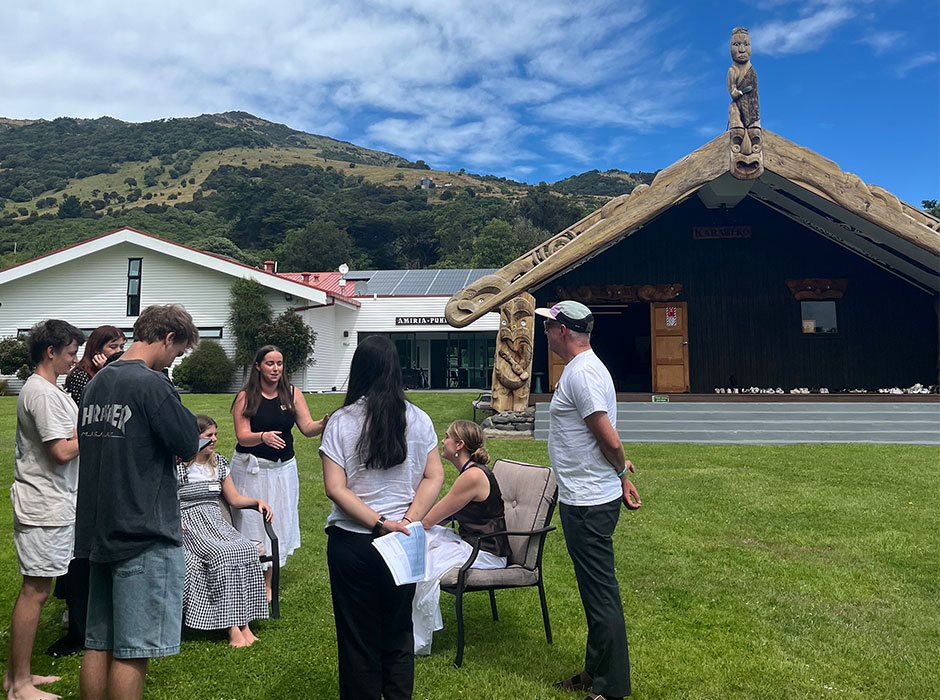
Medical students from the Faculty of Medicine - Christchurch, are welcomed onto Ōnuku Marae with a mihi whakatau from Te Marino Lenihan (Kāti Māmoe/Ngai Tahu).
At 6.45am on two weekday mornings in late January, buses pull away from the University of Otago – Faculty of Medicine, Christchurch, transporting all 125 of the campus’s fourth-year medicine cohort over the hills of Horomaka Banks Peninsula towards Akaroa Harbour. The destination is not a hospital ward or lecture theatre, but Ōnuku Marae - a place of deep historical and cultural significance, and for these students, the official launch of their learning in the Waitaha region.
For more than 20 years, the University’s Department of Māori Indigenous Health Innovation (MIHI) has taken tauira (students) to Ōnuku Marae as a learning experience in Hauora Māori. What began in 2003 with smaller student numbers at Rāpaki Marae, has grown into a defining feature of the Christchurch campus’s medical teaching.
“The wānanga marae is an important foundation visit and welcome by mana whenua,” Faculty of Medicine – Christchurch Dean, Professor Lutz Beckert says.
“The students’ Hauora Māori learning over the next three years will build on these foundations and translate into their clinical environments.”
Ōnuku is one of only three South Island marae where Te Tiriti o Waitangi was signed, and the place where former Prime Minister Jenny Shipley delivered the Crown’s formal apology to Ngāi Tahu. History here is embedded in the land, the harbour, and the wharenui.
Head of the Faculty of Medicine, Professor Suzanne Pitama (Ngāti Kahungunu), describes the day as both an orientation and an invitation.
“The time at Ōnuku Marae allows students who have been in Dunedin a chance to orient themselves to being in Canterbury, offering a supportive place to learn about how, as future doctors in our health system, they can improve current health inequalities,” Suzanne says.
The day begins with a pōwhiri, grounding students in tikanga Māori and the role of mana whenua. From there, the learning unfolds across the marae’s teaching spaces and wharekāi, facilities built with the support of the University of Otago following the Canterbury earthquakes.
Suzanne sees that investment as symbolic as well as practical.
“I think Otago’s investment alongside Ōnuku Rūnaka signalled an acknowledgment of our relationship at the time, and a commitment to an ongoing and enduring relationship,” she says.
“It symbolises our value of social accountability in utilising the marae, mana whenua expertise and the ongoing teaching of the place as significant in Te Waipounamu history, celebrating both historic and current milestones.”
The new teaching rooms have transformed the experience. In earlier years, students slept and learned in the wharenui or under a marquee. While COVID-19 restrictions and growing class sizes mean students no longer stay overnight, the learning outcomes remain strong.
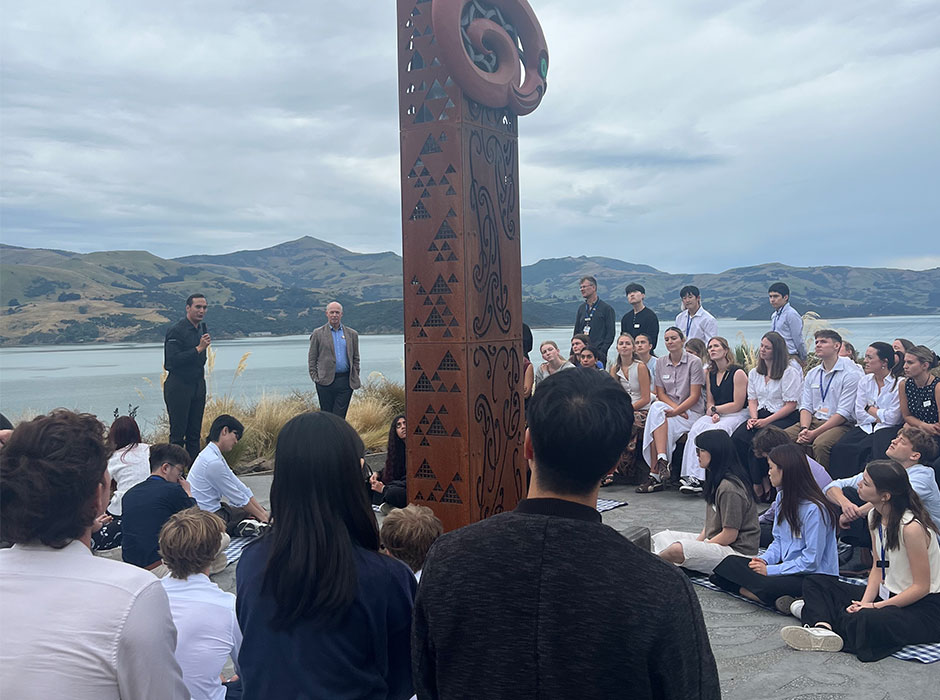
Faculty of Medicine - Christchurch Dean, Professor Lutz Beckert, leads a small group teaching session with fourth year medical students at Ōnuku Marae.
Looking ahead, MIHI is exploring a noho marae experience for sixth-year students.
For many students, the emotional and intellectual centrepiece of the day is the lecture, Why Study Māori Health?
“Over many years, the students have consistently rated this lecture as a highlight,” MIHI Clinical Senior Lecturer Dr Maira Patu (Ngāi Tahu, Kati Mamoe, Waitaha, Te Arawa) says.
“Suzanne presents colonisation and its impacts on Māori health in a way that creates a safe learning environment - one where students can listen openly, ask questions, and engage without fear of blame.”
Maira says by the end of the kōrero, tauira understand colonisation not as a distant historical event, but as an ongoing structural force shaping inequities in health outcomes.
Students are then introduced to two core Māori health models underpinning Otago’s medical curriculum: the Hui Process and the Meihana Model.
The Hui Process describes four key elements of a culturally responsive clinical encounter:
Mihimihi (initial greeting), Whakawhanaungatanga (making connections), Kaupapa (attending to the purpose of the visit), and Poroaki/Whakamutunga (closing the session).
The Process is taught alongside the Meihana Model - a framework that situates the patient within the context of whānau (family), wairua (the spirit), tinana (physical body), hinengaro (mental health), taiao (the natural world) and iwi katoa (societal structures). These tools support students to engage meaningfully with Māori patients and whānau.
“For the remainder of the day, we focus on teaching students practical ways to implement the Hui Process and Meihana Model in their clinical practice as they begin seeing patients,” Maira says.
“This creates a strong balance between historical context and applied learning, equipping students with practical, anti-colonial and anti-racist approaches that can be meaningfully integrated into everyday clinical practice.”
In one afternoon session, tauira are divided into eight groups, analysing key cultural components of the Meihana Model; Nga Hau E Wha (the four winds) reflecting key cultural components of the Māori worldview of colonisation, racism, migration and marginalisation; and Nga Roma Moana (the ocean currents) reflecting the positive cultural elements supporting a person’s journey to health, namely personal indicators or āhua, customs or tikanga, whānau and whenua (land).
Students examine common Māori health issues, applying a Meihana Model lens, presenting their findings to the wider group in a variety of forms, from skits, charades, poetry, song and even mock-up news presentations.
Along with a beautiful harbour environment, supportive teaching and wonderful kai provided by Ōnuku marae, students rate the day highly.
“It’s been so beneficial, learning why there are such health inequities and how we can best, in future, work with Māori patients to achieve better outcomes for them,” student Aden Li says.
“I’ve really loved it,” Laura Balmer says.
“The morning lecture was factual, enjoyable and really informative, and learning about the Meihana Model and Hui Process gives us a valuable tool for our future as clinicians.”
Such student feedback has consistently affirmed the programme’s value.
A 2017 study published in BMC Medical Education analysed evaluations from 602 students over eight years. Ninety-two per cent rated the Indigenous health orientation programme as extremely or highly valuable, and 87 per cent reported that it significantly increased their interest in Indigenous health.
Students highlighted the importance of learning in an authentic Indigenous environment, the passion and role-modelling of faculty, and the integration of Māori history and health frameworks into clinical practice. Many described increased confidence and competence in engaging with Māori patients.
Lutz says regular evaluation remains central to the programme’s quality assurance.
“The value and importance of the Ōnuku Marae foundation days cannot be under-estimated in terms of helping us produce doctors of the future with high standards of cultural competency and skill.
“We are incredibly grateful for the support of the Rūnaka and those who fulfil the roles and responsibilities on the marae for their ongoing support and Manaakitanga.”
Study Medicine in Christchurch
Staff provide a range of medical attachments to ensure that students develop the clinical skills necessary to take an accurate history and examination from patients, and learn the role of basic investigations.
View