
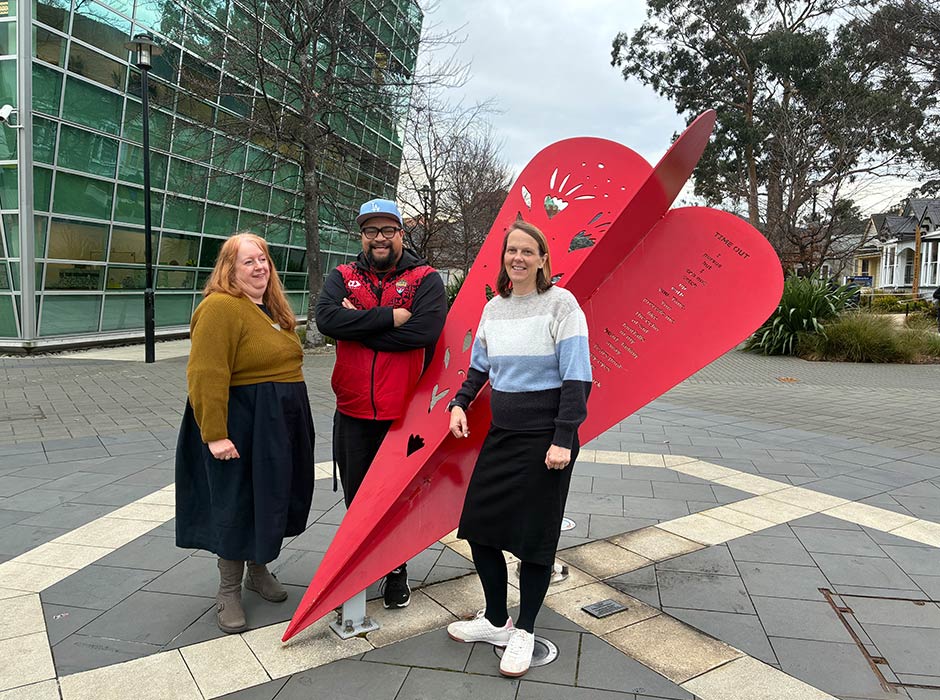
Professor Sarah Wakes (Mathematics), Senior Lecturer Edmond Fehoko (Human Nutrition), and Professor Katherine Black (Human Nutrition), are ready to help postgraduate students solve wicked problems.
The University of Otago is a place of many New Zealand firsts – the first medical school, the site of the first radio broadcast, the first university to achieve Fair Trade status – and now the first university to offer a postgraduate paper in Māori, Pacific and global Indigenous science.
Global Indigenous Worldviews in Sciences is one of three new postgraduate papers designed to equip students for the evolving workforce and empower them to make positive change in our complex world.
Senior Lecturer Edmond Fehoko says the immersive, interactive paper will be grounded in Māori, Pacific, Aboriginal Australian, Middle Eastern, Indigenous Nordic and other First Nations cultures.
“It’s an opportunity for students of a non-Indigenous background to get a sense of Indigenous science, and for Indigenous students, it’s an opportunity to get a sense of identity,” Edmond says.
“It’s also grounding for the University. We’ve now got a paper dedicated to Indigenous science, knowledge and world views. We want to be the university that leads in equity and Indigeneity.”
Edmond’s vision for equipping students with hard data and soft skills is shared by Professor Katherine Black, whose paper Solving Wicked Problems launches in October.
“A wicked problem is a problem that would make the world a better place if it was solved,” Katherine says, citing examples such as child poverty, housing affordability and climate change.
“One of the first things the class will do is choose a wicked problem to tackle. With a wicked problem there isn’t one correct answer, and everyone will have a contribution to make. They can tailor it towards their interests and experience.”
Applying the knowledge gained during their 400-level studies, students will devise a potential solution and develop a prototype.
“They’ll develop teamwork, communication and reflection skills, and personal development as well,” Katherine says.
Professor Sarah Wakes, whose paper Resources, Design and Sustainability starts this month, will also challenge learners to solve real-world issues.
“They’ll actually get their hands dirty, and when they go into the workforce, they’ll be able to say, ‘I did this challenge and this is what I achieved',” Sarah says.
Though the papers sit within the Division of Sciences, they are open to all postgraduate students.
“We know the problems of the world are not solved by just one discipline,” Sarah says.
“We have to learn to work together, speak a common language, and use each other’s skills and knowledge. We’re teaching the multidisciplinary effort that goes into solving problems: the systems thinking, creativity and analytical thinking.”
Katherine adds that bringing sustainability, problem solving and cultural competency into our everyday lives will make us more effective.
“We’ll take different perspectives into account when we make decisions. It’ll make us better people,” she says.