
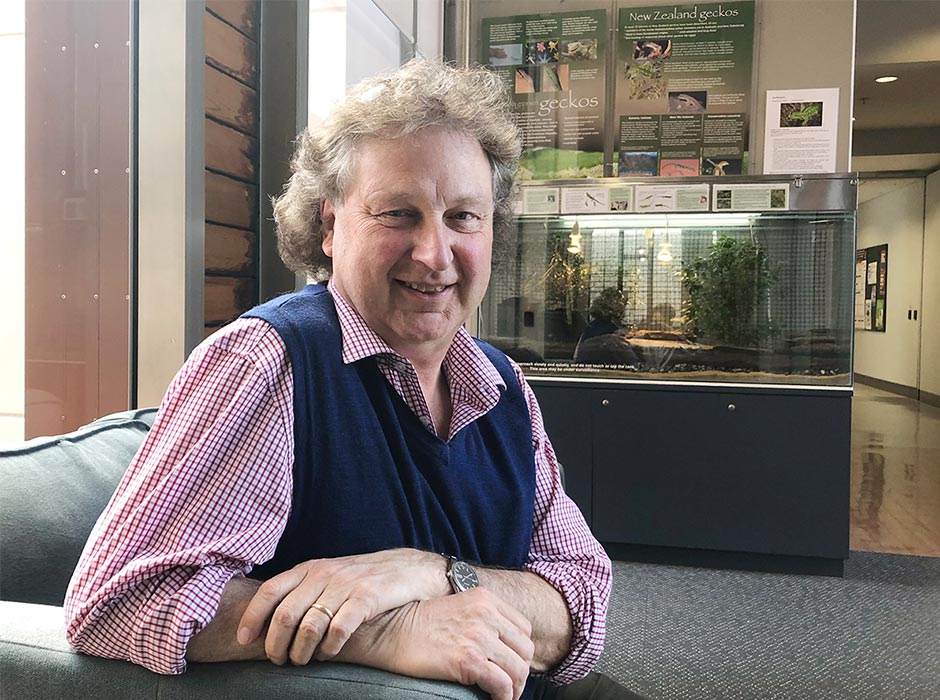
Emeritus Professor Hamish Spencer was based in the Department of Zoology from 1992 till his recent retirement.
Emeritus Professor Hamish Spencer recalls that, even when he was a child collecting shells from his local Bay of Plenty beaches, he was fascinated by the diversity of animals and how they relate to each other. However, it was his postgraduate studies, when Hamish developed mathematical models to investigate how new species arise, that really hooked him into the field of evolutionary genetics.
Moving to Harvard University in the United States for his PhD studies, Hamish constructed a variety of mathematical models to investigate several different problems in evolution: how new species arise and whether or not natural selection can maintain genetic variation in natural populations.
His research also explored statistical measures of mate choice that serendipitously played out in his personal life at the time when he crossed paths with now Emeritus Professor Abby Smith.
Their meeting would be the start of what would be a lifelong partnership. After moving with Abby back to New Zealand to support her doctoral work, Hamish secured a lecturer role in Otago’s Department of Zoology and in 1992 the couple moved to Dunedin.
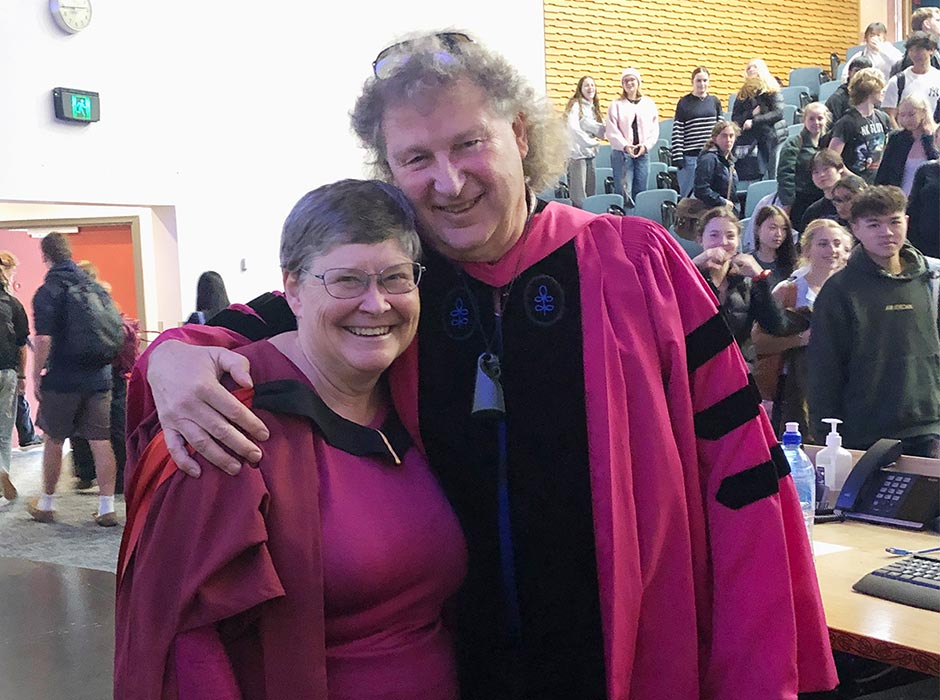
Emeritus Professors Hamish Spencer and Abby Smith at Hamish’s final lecture before retirement.
Hamish has undertaken research across a wide variety of topics in evolution and genetics and has published more than 170 scientific articles. Much of his work involves mathematical modelling of genetic changes that occur in human, animal and plant populations. Most recently, he has worked on incorporating the effects of epigenetic modifications into the standard models of evolutionary genetics.
He says one of the motivating questions for his career’s work can be traced back to his PhD research.
“It actually extends beyond that time to my supervisor and, indeed, his supervisor, Theodosius Dobzhansky: Why is there so much genetic variation in natural populations of almost every species? My research has revealed that understanding the way in which levels of genetic variation evolve over time is critical.”
Hamish’s most recent work, for his James Cook Fellowship, has shown that the way in which genetic variation is distributed along the different chromosomes can make an enormous difference to how that variation is maintained over long periods of time.
Over his career, Hamish has earned a substantial list of accolades including being made a Fellow of the Royal Society of New Zealand in 2009. He also received the Royal Society of New Zealand’s Callaghan Medal in 2016 for his outstanding contribution to science communication and raising public awareness of the value of science to human progress.
In 2019 Hamish was in the first cohort of University of Otago Professors who were recognised as Sesquicentennial Distinguished Professors for their outstanding teaching and research, together with their well-established track-record of sharing their work with a wide range of communities.
For Hamish this included outreach interactions with two Māori-led communities in Tolaga Bay and Muriwai in Tairāwhiti, through his role leading the Allan Wilson Centre, a Centre of Research Excellence. He considers this interaction as one of the most fulfilling of his career and says the “mutual learning experience helped me appreciate the benefits of a wider perspective to scientific investigations.”
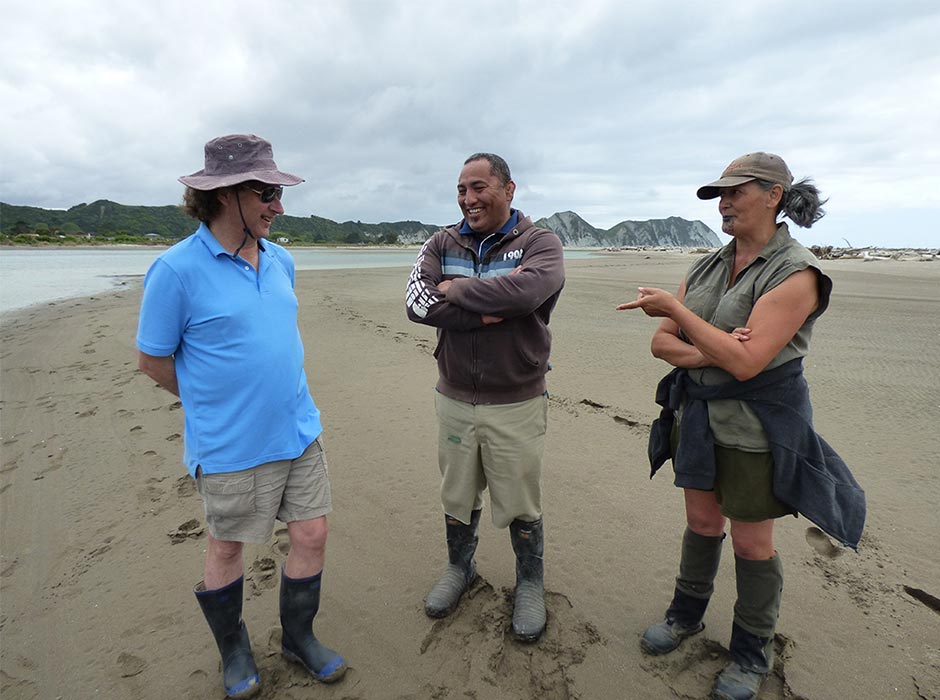
Hamish Spencer interacts with community members on the estuary at Tolaga Bay in Tairāwhiti. Photo: Mark Coote
His commitment to ensuring science makes a difference was reflected in his behind-the-scenes role as a science advisor to the Ministry of Business, Innovation and Employment. He then participated in the Ministry’s Science System Advisory Group and the University Advisory Group, both of which were chaired by Sir Peter Gluckman.
“I think the reports that these bodies produced make some truly excellent recommendations,” Hamish says.
“They have the potential to greatly improve the practice and delivery of research, and the functioning of universities.”
In 2022 Hamish was awarded the prestigious three-year Royal Society of New Zealand James Cook Research Fellowship. Using new mathematical models in conjunction with computer simulations, his research enhanced understanding of how evolutionary processes interact with each other and shape genetic variation.
“This research improved what are currently overly simplistic mathematical models to explain the levels of genetic variation seen in nature. It has implications for fundamental evolutionary biology as well as agriculture, conservation and medicine.”
While Hamish holds many great memories from his time at Otago, he’s very proud of his PhD students and their growth into intellectually independent practitioners.
“For example, they now use in their jobs skills I didn’t teach them. They learnt from me how to ask hard questions and then to work out how to tackle those questions. Recently, three of my ex-PhD candidates were promoted to full professor at different universities around the world, which was a pretty special thing.”
During their working lives in Dunedin, Hamish and Abby raised two sons, both of whom went on to study at Otago and followed their Dad’s interest in mathematics and statistical modelling. Their eldest son Ned majored in Economics and currently works overseas in health economics, while younger son David achieved Honours in Maths and works as a data scientist and consultant.
As an academic couple, their lives have been intertwined by a shared curiosity of the natural environment and workings of the world. These connecting points also mean they’ve supported and influenced each other in their careers.
“Abby is relentlessly student-focussed, always trying to do things (whether teaching in a course, dealing with degree regulations, or addressing a non-academic problem) in a fair and reasonable way that works best for the students. She is a stickler for clear communication and often offers excellent advice about how to achieve that goal. And I admire that she always wants to be fair, something which I do my best to emulate.”
In the lead up to his recent retirement, Hamish says he’s delighted to have the book Beyond Equilibria: Historical Approaches to Ecology and Evolution published by Oxford University Press. In the publication, Hamish argues that ecologists and evolutionary biologists would benefit from taking a more explicitly historical view of their research systems.
“This body of work brought home to me the importance of understanding scientific questions in context. Doing so enables one to understand more clearly how scientific ideas have developed and, thus, how the questions scientists sought to answer might be differently (or better) framed. It also shows how scientific results can be used, and sometimes misused, in our society.”
- Kōrero by Guy Frederick (Sciences Communications Advisor)
Study Zoology at Otago
Did you know that New Zealand’s only mammals were bats and seals, until about 1000 years ago? Animals are fascinating and there is so much to learn about them – the Zoology courses at Otago will blow your mind.
Find out more