
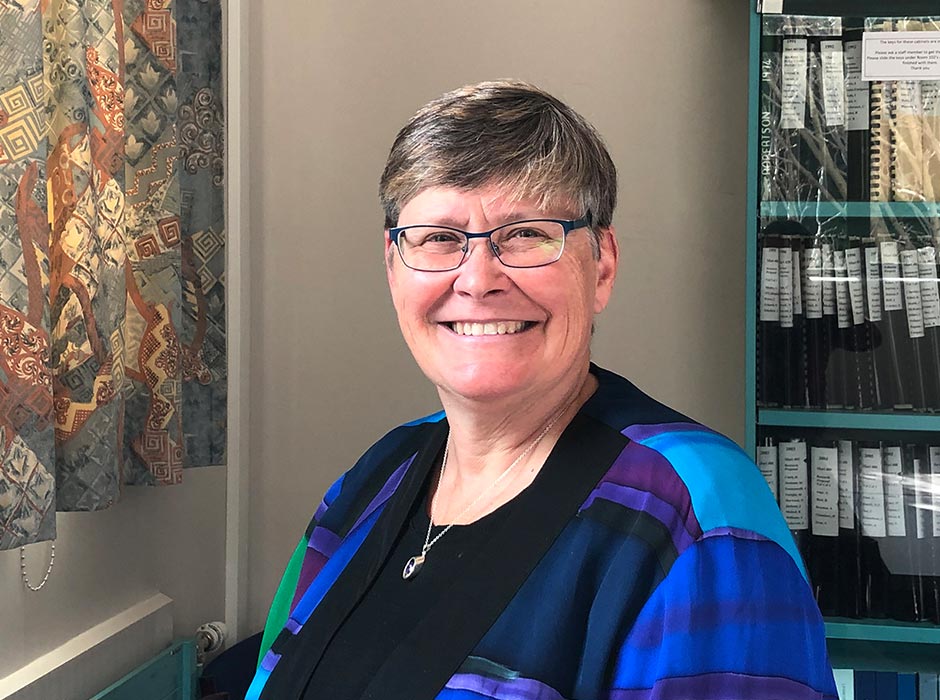
Emeritus Professor Abby Smith started in the Department of Marine Science in 1993 where she was based till her recent retirement.
Marine science academic Emeritus Professor Abby Smith wasn’t even aware of the term ‘bryozoan’ prior to moving to New Zealand. Her supervisor at University of Waikato suggested that she conduct doctoral research on bryozoans.
“What’s a bryozoan?” was Abby’s reply.
It turns out bryozoans are tiny aquatic invertebrates that live in colonies and form intricate, plant-like structures.
“After some investigating, I agreed that bryozoans were well worth studying, and I have loved them now for over 35 years,” Abby says.
“In the southern hemisphere marine environment, bryozoans are important, abundant, and stunning.”
Accompanying American-born Abby on her move to New Zealand was husband and now Emeritus Professor Hamish Spencer. Their paths had first crossed when they were both students in the United States. With his PhD completed, Hamish gained his first lectureship at Waikato and the couple then moved to Otago when he secured a role in the Department of Zoology.
Abby started as a part-time temporary lecturer in 1993 in the Department of Marine Science where she was based till her recent retirement. Her research path began with an interest in studying skeletal carbonate sediments, then moved to bryozoans as a particular kind of skeletal sediment and ended up including the chemistry of their skeletons.
As a sedimentologist and a geochemist, her primary area of research explored the composition and construction of marine shells, including the taxonomy, distribution, and significance of marine bryozoans in New Zealand.
“While still doing some basic sedimentology, I continued to look at how critters make their shells, out of what materials, and why. In the end, this moved me into the research area of ocean acidification, combining my interests in marine carbonate sedimentology and ocean chemistry.”
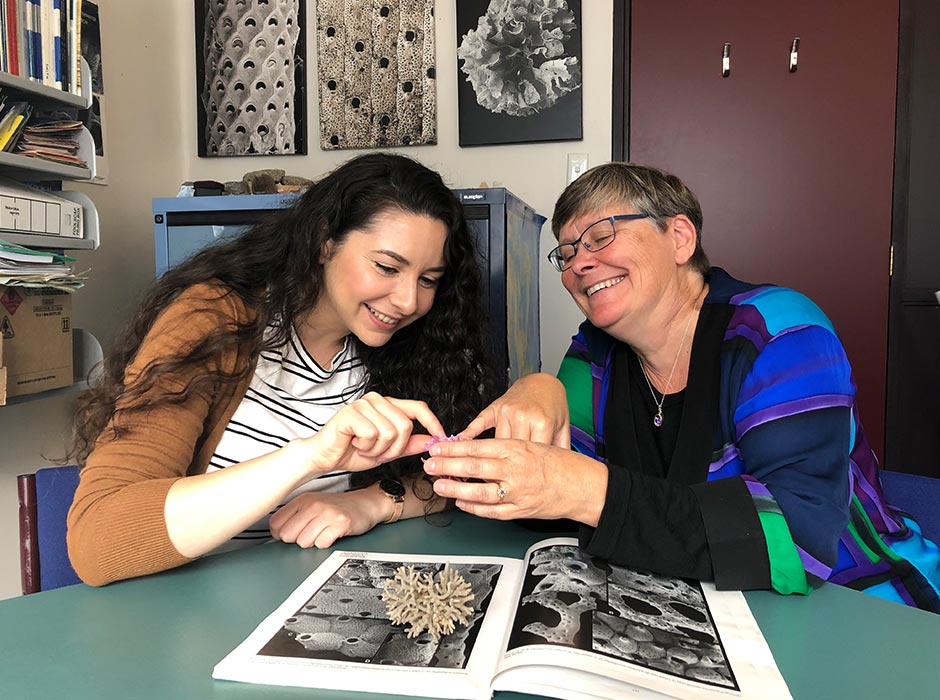
Abby with one of her PhD students Katerina Achilleos in 2019 who was studying bryozoans.
In addition to her academic promotion to Professor in 2016 and acting as Head of Department for four years, Abby has led several national research initiatives and chaired the New Zealand Ocean Acidification Community. She’s also received numerous accolades, including the New Zealand Marine Sciences Society Lifetime Achievement Award for outstanding contributions to marine science, and recently the Ellis Medal as the highest award of the International Bryozoology Association.
Abby has been instrumental in supporting the development of marine reserves in Otago, particularly the Papanui Marine Reserve with the hope it will protect offshore bryozoan meadows. Her very last research project on the University’s vessel RV Polaris II was to find out the growth rate of these bryozoan meadows which are located 60-80 metres below sea level.
Beyond her academic accomplishments, Abby has been recognised for her advocacy efforts and commitment to equity. In 2019, she received the Miriam Dell Award for Mentoring of Women in Science from the Association of Women in Science for her work encouraging diversity and inclusiveness in the Department of Marine Science.
Responding to the award at the time, Abby said, “As an educator and a scientist, it’s my job to encourage, enable, and include people who want to learn and grow. And of course, when I do, I also learn and grow.”
When reflecting on the highlights of her time at Otago, for Abby it’s unequivocally been her colleagues and students.
“I have really enjoyed them both, and they have supported me through thick and thin. I had opportunities to grow and lead, opportunities to learn and travel, and plenty of laughs.”
“Watching young people learn and grow during their postgraduate years is a particular joy — at some stage they just seem to ‘get it’ and it’s wonderful watching the lights go on.”
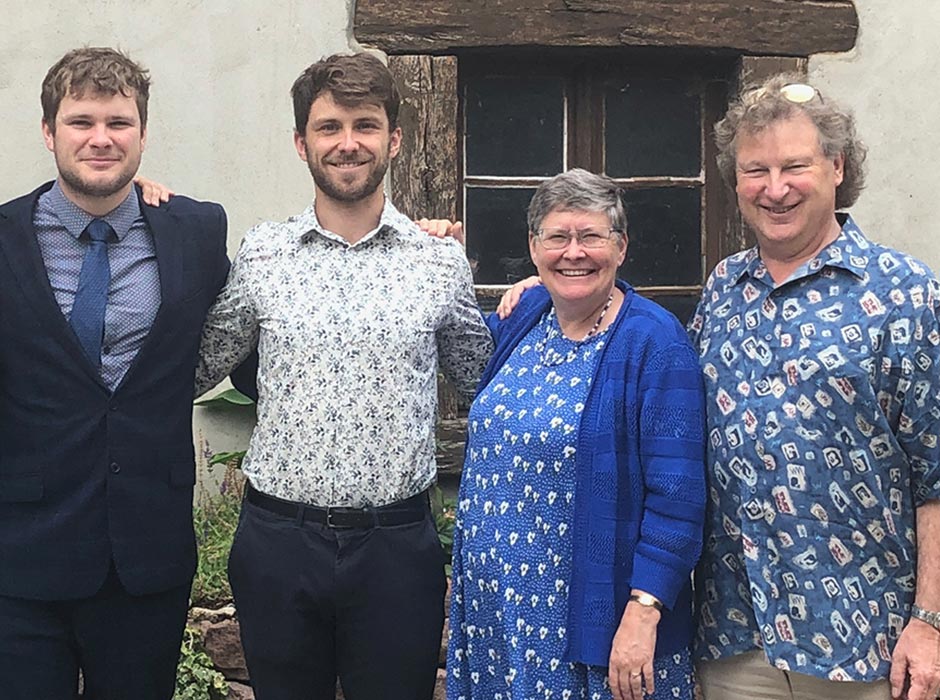
A family photo from 2023 captures Abby and Hamish with their two sons who studied at Otago - David (at left) studied Maths and Ned majored in Economics.
While growing successful academic careers, Abby and Hamish have also raised their own family during their working lives at Otago. Their two sons went on to study at the University of Otago; eldest son Ned majored in Economics and younger David in Maths.
As an academic couple, the lives of Abby and Hamish have been intertwined with a shared curiosity about the natural environment and workings of the world. These connecting points mean they’ve supported and influenced each other in their careers.
“A thing I admire about Hamish is how he balances being rigorous and really committed to doing things the right way while being flexible, kind and interested in the people around him. He is often very funny. He reminds me never to give up on a project or piece of research, but to keep looking for the right place to publish or present it.”
An enduring legacy of the couple includes having species named after them several years ago. A British scientist based at the Natural History Museum in London and a New Zealand colleague named a tiny bryozoan Exochella abigailae after Abby, while a deep-water snail found off the coast of New Zealand was named Hortia spenceri in honour of Hamish’s work with molluscan species. Together, Abby and Hamish have also written a regular column on biodiversity for the Otago Daily Times since 2019.
Now an Emeritus Professor, Abby has no shortage of activities and interests to keep her busy in her recent retirement.
“I loved my career! But I’ve never wanted to be a person who is only known for working. It’s too common for a scientist to think that her work is all she is. I’ve always introduced myself as a marine scientist but have been quick to add my personal interests that range from cricket to singing, knitting, writing, foraging and preserving!”
Abby is guided by a simple recipe when it comes to the life she’s keen to lead and the legacy she wishes to leave.
“Basically, I’m a person who likes to be busy, who likes to make things, and who wants to leave the world a little bit better because I was here.”
- Kōrero by Guy Frederick (Sciences Communications Advisor)
Marine Science at Otago
Are you passionate about the oceans, fascinated by marine life and driven to protect our planet’s most precious resource? Gain the knowledge and skills to become a leader in Marine Science and be part of a community that is dedicated to safeguarding the future of our oceans.
Explore marine science