Career opportunities
A Marine Science degree opens doors to diverse and impactful careers. Otago graduates work in research, conservation, government, education, and industry – both in New Zealand and around the world. Employers include NIWA, the Department of Conservation, MPI, local councils, consultancies, and NGOs. Potential careers include:
- Marine biologist
- Oceanographer
- Environmental consultant
- Fisheries scientist
- Aquaculture specialist
- Marine policy adviser
- Research technician
- Coastal resource manager
From sharks to sustainability
Study Marine Science at Otago and be part of real-world research. Work in the field, learn from top scientists, and help find solutions to the biggest challenges facing our oceans.
Read transcript
José Trujillo:
Hello, I’m José Trujillo. I’m a PhD student at the Marine Science Department, looking at behavioural ecology in young sharks.
Studying at Otago gave me the opportunity to do research with sharks in French Polynesia at a level that I couldn’t have imagined before. I think it was the very supportive environment that made me feel that my ideas were important and that my project matters. That, to me, is the number one reason to choose Otago over other universities.
Dr Bridie Allan:
Hi, I’m Bridie Allan. I’m a lecturer here at the University of Otago in the Department of Marine Science.
I hear you’re thinking about taking Marine Science. Marine Science is a multidisciplinary area of research and study. Essentially, that means marine scientists work across a number of different disciplines to understand how the marine environment is working.
Why is Otago such a great place to study Marine Science? There are two key reasons.
The first is that we are incredibly well equipped to study the marine environment. We have the Southern Ocean on our doorstep, a world-class marine lab just 30 minutes from the city, and access to a range of different research vessels. We also have study sites on Stewart Island and in Fiordland.
Undergraduates at Otago can expect to take a range of papers, covering everything from the biology and behaviour of marine invertebrates to large charismatic megafauna such as whales. We have a strong focus on fisheries and aquaculture—two really important topics as human populations continue to grow. We also explore physical and biological oceanography, and we study marine ecosystems as a whole through marine ecology.
And I can guarantee you’ll get your hands wet on multiple occasions as you participate in labs at the Portobello Marine Lab and gain valuable research experience on board our research vessels.
Now, I mentioned two reasons. The second is our people.
Our lecturers are dedicated to giving you the best learning experience possible while also being leaders in their own research fields. We have biologists, ecologists, physical oceanographers, chemists, and geologists. I myself am a behavioural ecologist—I study the behaviour of animals in their environment and, importantly, how that behaviour will change under future environmental conditions.
Because of our diverse research expertise, we work in a range of different locations—from Antarctica, the Auckland Islands, New Zealand of course, the South Pacific, and the Great Barrier Reef, which is where I do my research. We study a vast range of organisms, from sea urchin larvae and kelp forests to tropical and temperate fishes like sharks, and of course, whales.
Now more than ever, we need to focus on the marine environment, which faces increasing threats from global warming, ocean acidification, and marine pollution. We want our students here at Otago to work with us towards a more sustainable marine future.
There’s an ocean of opportunities here at Otago studying Marine Science—join us here at Otago to study the marine environment.
How you will learn
Marine Science is a hands-on, field-intensive subject. Alongside lectures and tutorials, you’ll gain valuable experience through laboratory work and coastal or offshore field trips.
Otago offers exceptional facilities, including:
- A fully equipped teaching and research centre on the Dunedin campus
- The Portobello Marine Laboratory, situated on the Otago Peninsula
- Remote field stations on Stewart Island and in Doubtful Sound
- A dedicated fleet of research vessels, including the RV Polaris II
You’ll develop practical skills in scientific diving, data collection, marine technology, analysis, and science communication – giving you the tools to thrive in the field or in further study.
Recommended high school subjects for undergraduate study
To prepare for a degree in Marine Science, we recommend taking biology, chemistry, physics, and statistics or calculus in Years 12 and 13.
Choose a study option
Whether you're embarking on your academic journey with our comprehensive undergraduate programmes or aiming to reach new heights through our advanced postgraduate offerings, Otago is here to support your aspirations.
Undergraduate qualifications
For new and current students studying towards a Bachelor's or other first degree. Explore undergraduate qualifications at Otago, designed to build a strong foundation in your chosen field, preparing you for a successful career or further study.
Note: this subject can also be studied as a minor.
Bachelor of Science (BSc)
A three-year degree offering flexibility to explore a major in Science along with other subjects
Bachelor of Entrepreneurship (BEntr)
A three-year degree that equips you to change the world as you create new products, services and ideas
Bachelor of Sustainability (BSust)
A three-year degree with a core sustainability focus, combined with a major from Sciences, Commerce, or Arts and Social Sciences.
Ready to apply?
Take the first step towards your future in this subject.
Further study opportunities
Whether you are looking to bridge your undergraduate studies to advanced knowledge or aiming to specialise in a specific field, Otago offers a range of graduate and postgraduate options to suit your aspirations.
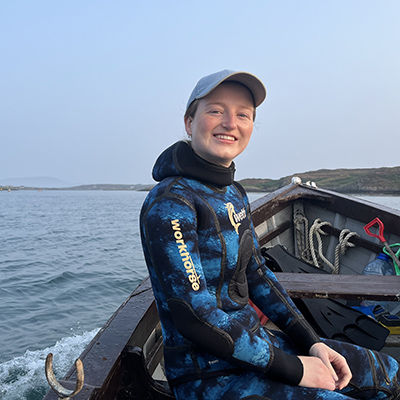
One of the reasons I was drawn to Marine Science is the variety it offers. There are so many things you can do in a day, from working in the lab, going out on the boat, or diving. During my postgrad studies I enjoyed getting involved with local community initiatives – helping out with the East Otago Taiāpure pāua/habitat surveys, presenting my PhD work at Taiāpure research evenings, and helping with the Ngāi Tahu Undaria control programme.
Isla Twigg
Doctor of Philosophy (Marine Science), Bachelor of Applied Science with Honours (Aquaculture and Fisheries)
Related subject areas
Explore all subject areasAnimals and life sciences
For those that love animals, plants, and nature, are curious about life on our planet and how living organisms interact
Environment, climate change and sustainability
Find creative solutions to the challenges posed by climate change and other environmental issues
Physical sciences
Answer fundamental questions about nature and the universe and provide solutions by studying the world around us
Oceans of opportunity
The University of Otago is New Zealand’s leading university for Marine Science – a global centre of excellence in coastal and ocean research. Our programme is one of the most comprehensive in the Southern Hemisphere, giving you a deep and integrated understanding of the marine world.
With direct access to a wide range of marine environments – from sandy shores and rocky reefs to estuaries and deep-sea ecosystems – Otago offers unmatched opportunities for real-world learning. You’ll study alongside internationally renowned scientists and contribute to groundbreaking research that informs environmental policy, conservation efforts, and climate solutions.
With its global reputation, immersive teaching, and commitment to sustainability, Otago is the ideal place to launch your Marine Science journey.
Programme details
Compare programmes for this subject.
| Level | Papers | Points |
|---|---|---|
| 100-level | EAOS 111 Earth and Ocean Science | 18 |
| MARI 112 Marine Biology: The Living Ocean | 18 | |
|
One of COMO 101 Modelling and Computation MATH 120 Mathematics for Scientists MATH 130 Fundamentals of Modern Mathematics 1 MATH 140 Fundamentals of Modern Mathematics 2 STAT 110 Statistical Methods STAT 115 Introduction to Biostatistics | 18 | |
| 200-level | MARI 201 Oceanography: The Physical Ocean | 18 |
| MARI 202 Ecology and Biology of Marine Invertebrates | 18 | |
| 300-level | AQFI 301 Field Methods in Applied Marine Science | 18 |
|
Two of: AQFI 352 Fisheries Ecology MARI 301 Marine Ecology and Ecosystems MARI 302 Biology and Behaviour of Marine Vertebrates MARI 322 Coastal and Shelf Seas Oceanography | 36 | |
| One additional paper in AQFI, BTNY, CHEM, COMO, ECOL, ENRG, ENVI , GEOG, GEOL, MARI, MATH, NAUT, PHSI, SCOM , STAT, or ZOOL | 18 | |
| Plus |
198 further points; must include 72 points at 200-level or above Up to 90 points may be taken from outside Science Notes: (i) Students should check the prerequisites for 300-level papers when selecting 200-level papers. (ii) Students majoring in Marine Science will not be permitted to major or minor in Aquaculture and Fisheries. | 198 |
| Total | 360 |
Effective 2026 onwards
| Level | Papers | Points |
|---|---|---|
| 100-level | EAOS 111 Earth and Ocean Science | 18 |
| MARI 112 Marine Biology: The Living Ocean | 18 | |
|
One of COMO 101 Modelling and Computation MATH 120 Mathematics for Scientists MATH 130 Fundamentals of Modern Mathematics 1 MATH 140 Fundamentals of Modern Mathematics 2 STAT 110 Statistical Methods STAT 115 Introduction to Biostatistics | 18 | |
| 200-level | MARI 201 Oceanography: The Physical Ocean | 18 |
| MARI 202 Ecology and Biology of Marine Invertebrates | 18 | |
| MARI 204 Marine Ecology and Ecosystems | 18 | |
| 300-level | AQFI 301 Field Methods in Applied Marine Science | 18 |
|
Two of: AQFI 352 Fisheries Ecology MARI 302 Biology and Behaviour of Marine Vertebrates MARI 322 Coastal and Shelf Seas Oceanography | 36 | |
| One additional paper in AQFI, BTNY, CHEM, COMO, ECOL, EMAN, ENVI , GEOG, GEOL, MARI, MATH, PHSI, STAT, or ZOOL | 18 | |
| Plus |
180 further points; must include 72 points at 200-level or above Up to 90 points may be taken from outside Science Notes: (i) Students should check the prerequisites for 300-level papers when selecting 200-level papers. (ii) Students majoring in Marine Science will not be permitted to major or minor in Aquaculture and Fisheries. | 180 |
| Total | 360 |
A minor subject can be included in many of our undergraduate degrees. To earn a minor, you typically must complete a minimum of 90 points in that subject, with at least 18 points at the 300-level.
Your minor can be a subject more commonly taken for a different degree. For example, a BCom majoring in Marketing can include Japanese as a minor subject. To include this subject as a minor in your application, first find a major subject through our Subject Search or Study Match.
You can check what’s required to receive the minor accreditation in the programme details below.
Available as a minor subject for a Bachelor of Arts (BA), Bachelor of Music (MusB), Bachelor of Performing Arts (BPA), Bachelor of Theology (BTheol), Bachelor of Science (BSc), Bachelor of Commerce (BCom), Bachelor of Entrepreneurship (BEntr), Bachelor of Health Science (BHealSc), Bachelor of Arts and Commerce (BACom), Bachelor of Arts and Science (BASc) or Bachelor of Commerce and Science (BComSc) degree
| Level | Papers | Points |
|---|---|---|
| 100-level | EAOS 111 Earth and Ocean Science One of: | 18 18 |
| 200-level | MARI 201 Oceanography: The Physical Ocean | 18 |
| 300-level | Notes: (i) Students who have passed at least one of COMO 101, MATH 120, MATH 130, MATH 140, STAT 110 or STAT 115 as part of another subject's requirements do not need to pass another one of these papers to fulfil the Marine Science minor subject requirements. (ii) Students should check the prerequisites for 300-level papers when selecting 200-level papers. (iii) Students majoring in Aquaculture and Fisheries will not be permitted to take a Marine Science minor. | 18 |
| Total | 108 |
Effective 2026 onwards
| Level | Papers | Points |
|---|---|---|
| 100-level | EAOS 111 Earth and Ocean Science One of: | 18 18 |
| 200-level | MARI 201 Oceanography: The Physical Ocean One of: | 18 |
| 300-level | Notes: (i) Students who have passed at least one of COMO 101, MATH 120, MATH 130, MATH 140, STAT 110 or STAT 115 as part of another subject's requirements do not need to pass another one of these papers to fulfil the Marine Science minor subject requirements. (ii) Students should check the prerequisites for 300-level papers when selecting 200-level papers. (iii) Students majoring in Aquaculture and Fisheries will not be permitted to take a Marine Science minor. | 18 |
| Total | 108 |
Papers
View a list of all related papers below.
MARI papers
| Paper Code | Year | Title | Points | Teaching period |
|---|---|---|---|---|
| MARI112 | 2026, 2027 | Marine Biology: The Living Ocean | 18 points | Semester 2 |
| MARI201 | 2026, 2027 | Oceanography: The Physical Ocean | 18 points | Semester 1 |
| MARI202 | 2026, 2027 | Ecology and Biology of Marine Invertebrates | 18 points | Semester 2 |
| MARI204 | 2026, 2027 | Marine Ecology and Ecosystems | 18 points | Semester 1 |
| MARI250 | 2026, 2027 | Special Topic | 18 points | Not offered in 2026, expected to be offered in 2028, Not offered in 2027, expected to be offered in 2028 |
| MARI302 | 2026, 2027 | Biology and Behaviour of Marine Vertebrates | 18 points | Semester 1 |
| MARI322 | 2026, 2027 | Coastal and Shelf Seas Oceanography | 18 points | Semester 2 |
| MARI350 | 2026, 2027 | Speciall Topic | 18 points | Not offered in 2026, expected to be offered in 2028, Not offered in 2027, expected to be offered in 2028 |
| MARI401 | 2026, 2027 | Advanced Methods in Marine Science | 20 points | Semester 1 |
| MARI403 | 2026, 2027 | Critical Thinking for Environmental Scientists | 20 points | Semester 1 |
| MARI429 | 2026, 2027 | Coastal Marine Environment | 20 points | Full Year |
| MARI431 | 2026, 2027 | Antarctic and Southern Ocean Science | 20 points | Semester 2 |
| MARI450 | 2026, 2027 | Special Topic | 20 points | Not offered in 2026, expected to be offered in 2028, Not offered in 2027, expected to be offered in 2028 |
| MARI451 | 2026, 2027 | Advanced Topics in Marine Science | 20 points | Not offered in 2026, expected to be offered in 2028, Not offered in 2027, expected to be offered in 2028 |
| MARI480 | 2026, 2027 | Independent Project | 40 points | 1st Non standard period (16 February 2026 - 7 November 2026), 2nd Non standard period (22 February 2027 - 22 November 2027) |
| MARI490 | 2026, 2027 | Dissertation | 60 points | 2nd Non standard period (16 February 2026 - 7 November 2026), 2nd Non standard period (22 February 2027 - 22 November 2027) |
| MARI495 | 2026, 2027 | Master's Thesis Preparation | 40 points | 1st Non standard period (16 February 2026 - 4 December 2026), 2nd Non standard period (22 February 2027 - 5 December 2027) |
More information
Have a question or need support? AskOtago can connect you with the right team for personalised help.
This information must be read subject to the statement on our Copyright & Disclaimer page.
Regulations on this page are taken from the 2026 Calendar and supplementary material.
Not sure what to study?
Take our short quiz to uncover study options matched to your background and interests.
Take the quiz