
Our secondary programmes are hands-on and designed to captivate students and teach them scientific techniques. The programmes align with New Zealand curriculum standards. Some programmes can be combined to make full-day or multi-day field trips.
Please note that the rates quoted are for New Zealand schools only and do not include GST. We are happy to adapt any of these programmes for other interested groups.
- Download brief details of all our secondary programmes (PDF)
- Keep up to date with our latest programme opportunities and news
2026 programmes
Adaptations and Behaviour
Mighty Molluscs or Crabs galore
How do adaptations identify a taxa and how do variations to these relate to a species' survival in it’s niche?
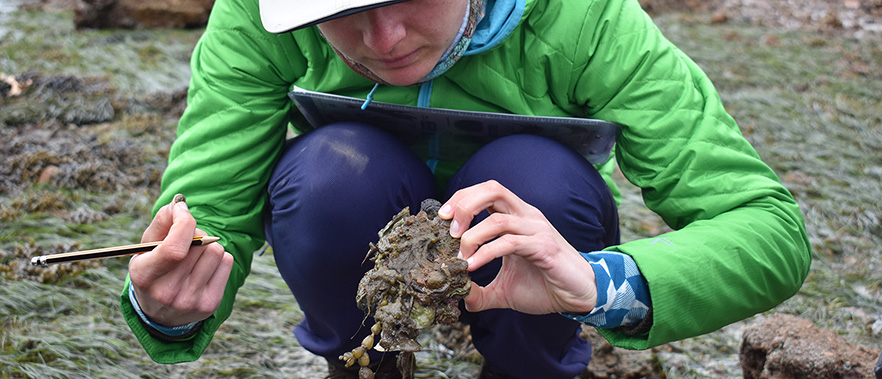
Classify molluscs or crustaceans, investigate how they feed and survey the intertidal zone to compare the distribution of their species.
- Years 9–10
- 3 hours
- $13.50 per student (GST excluded)
Intertidal investigation
Investigate adaptations and community structure on the rocky shore using appropriate sampling techniques either as a practice (formative) or final (summative) assessment for NCEA . Links well with Diversity in Form and Function for a full-day programme.
- Year 12
- Supports BIO2.6-AS91158 (can be adapted for SCI1.2-AS91921 and EASS2.4-AS91190)
- 3 hours
- $13.50 per student (GST excluded)
Diversity in form and function
A comparative study to look at structure and function in relation to survival in particular niches. Adaptations observed and demonstrated with living examples. Laboratory series of comparative dissections. Focus is flexible depending on teachers’ requirements: respiration/gas exchange, feeding/nutrition, or reproduction/life histories.
- Years 12–13
- Supports BIO2.6-AS91155 (can be adapted for BIO3.5 AS91605)
- 3 hours
- $13.50 per student (GST excluded) and $2 per student (GST excluded) for dissection
Small animal study
Carry out a practical investigation in a biological context. Focus on one animal species and investigate its behaviour in response to abiotic and biotic factors. Design and carry out individual student investigations. Includes support with reference materials and bioethics.
- Year 13
- Supports BIO3.1-AS91601 (can be adapted for BIO2.1-AS91153 and EASS2.4-AS91190)
- 19 hours approximately
- $4.50 per student per hour (GST excluded)
Behaviour of marine animals
Investigate the behaviour of marine animals in response to abiotic and biotic environmental factors. Living examples of symbioses, predator/prey adaptations, reproductive strategies and biological clocks. Laboratory series of mini investigations with live examples of taxes and kineses.
- Year 13
- Supports BIO3.3-AS91603.
- 2 hours
- $9 per student (GST excluded)
Socio-scientific issues, conservation, and local contexts
Meeting with a Marine Scientist
All our programmes can be supported either partly or fully by distance, allowing students to engage with our scientists. Examples are: i) support for data analysis and interpretation of 3.1 achievement standards in Science, ii) Discussion of socio-scientific issues, and iii) live induction to intertidal transect surveys so students are equipped to carry one out themselves.
- Online
- Years 9–13
- $60 per hour (GST excluded)
Marine plastics, from micro to macro
Investigate ocean currents and anthropogenic impacts through a survey of ocean litter, where data collected feeds directly into the New Zealand waste legislation. Provides students with the training, equipment and technology to take part as ‘Citizen Scientists’ in the Litter Intelligence Project.
- At the NZMSC or on your local shore
- Years 9–11
- Supports SCI1.1-AS91920 (can be adapted for EASS3.2-AS91411, BIO3.2-AS91602, and MATH1.1-91944)
- 3 hours. Tide dependant.
- $13.50 per student (GST excluded)
Ocean acidification
Carry out a practical investigation in an Earth and Space Science context. Focus on abiotic changes of a future ocean (pH and/or temperature) and investigate the potential physical, ecological, or behavioural impacts. Design and carry out individual student investigations. Under guidance, students do practical work and data collection. Includes support with reference materials and bioethics.
- Years 12–13
- Supports EASS3.1-AS91410 (can be adapted for EASS2.1-AS91187 and EASS2.4-AS91190)
- 19 hours approximately
- $4.50 per student per hour (GST excluded)
NZVR Caring for Taoka species
Experience Aotearoa New Zealand’s marine environment through Virtual Reality videos (Blake NZ-VR, New Zealand Geographic). Students will learn about the physiology and classification of marine mammals, explore the history of these animals in Aotearoa, and how scientists study them. Discuss environmental and anthropogenic factors that impact local extinctions, and come up with actions that we can take to better look after these species and protect the moana.
- In your classroom
- Years 9–11
- Supports SCI1.1-AS91920
- Class up to 35 students.
- 1–2 sessions $200 (GST excluded)
- 3–4 sessions $320 (GST excluded)
Monitoring the Moana participatory science
Use scientific methods to monitor marine communities in all scales. Choose between using microscopes to identify and count plankton, underwater cameras to look for sharks and identify fish, or quadrats to survey the shoreline.
- Years 9–13
- Can support SCI1.1-AS91920, SCI1.2-AS91921, and MATH1.1-91944
- 3 hours. May be tide dependant.
- $13.50 per student (GST excluded)
Customisable programmes
Our programmes can be customised to fit your class and enquiry topics. Most of our programmes can be adapted to fit different age groups and learning needs. Programmes can be combined to cover content of multiple topics/assessments in one day. Just get in touch with our educators to find out what we can do for you and your class.
Contact
For secondary education enquiries and bookings, contact:
Rob Lewis
Email rob.lewis@otago.ac.nz
Tel +64 21 279 0058