
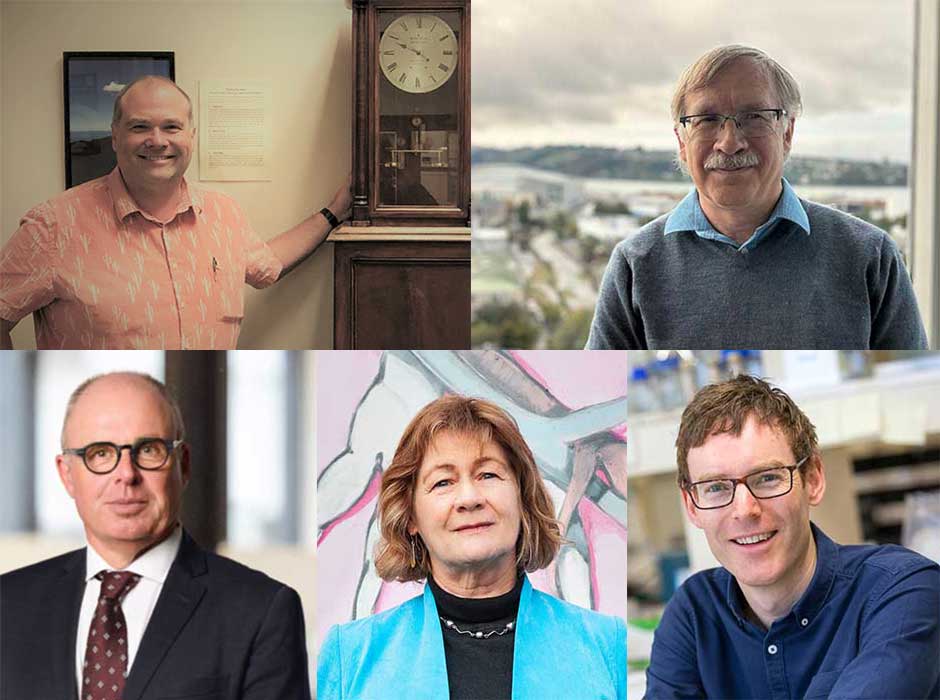
Clockwise from top left: Professors Craig Rodger, Etienne Nel, Peter Fineran, Janet Hoek, and Frank Frizelle are the incoming 2027 Distinguished Chairs - Poutoko Taiea.
The incoming group of University of Otago – Ōtākou Whakaihu Waka Distinguished Chairs - Poutoko Taiea are ready to take up the mantle in 2027.
Introduced in 2019, the biennial awards are designed to highlight the work of the University’s highest-achieving professors and to raise the profile of its work, enhancing the understanding, development and well-being of individuals, society, and the environment.
Those receiving the award this year are Professors Peter Fineran, Frank Frizelle, Janet Hoek, Etienne Nel, and Craig Rodger.
Vice-Chancellor Grant Robertson says the 2027 recipients represent the epitome of Otago’s world-class researchers.
“The decades of significant research these professors have produced has influenced national and overseas government policy and practice, and has also led to a range of life-changing outcomes.
“These are people who are also out there every day engaging with the public in tangible, meaningful ways.
“I am excited to see how they use their appointments to share their research widely with communities and the next generation of researchers.”
The award is bestowed for a fixed period, during which the recipients will be provided with the opportunity to showcase their work and to engage and inspire others.
They will take up their appointments in January.
Professor Peter Fineran, Department of Microbiology and Immunology
Professor Fineran leads the Phage-host interactions (Phi) laboratory, which investigates how bacteria defend themselves against viruses (bacteriophages) and how these viruses overcome bacterial defences.
His research has made significant contributions to understanding CRISPR-Cas systems, the bacterial immune mechanisms that have also revolutionised biotechnology and gene editing.
It spans fundamental discoveries through to real-world applications, including co-leading an MBIE-funded programme developing phage-based solutions to combat bacterial plant pathogens, including those affecting New Zealand's cherry industry.
“I'm delighted and honoured to receive this appointment,” he says.
“Otago has provided a fantastic environment in which to build my research career, working alongside talented students, colleagues and collaborators from around the world.
“It's wonderful to have our collective achievements recognised, and I'm particularly excited about the opportunity to help others achieve their own research ambitions and contribute to the wider success of research at the University.”
Professor Fineran intends to raise Otago's international profile, strengthen research collaborations and help turn exciting scientific discoveries into real-world benefits.
“My own experience has shown how curiosity-driven research can lead to unexpected innovations, from advances in biotechnology to new approaches for challenges in health, agriculture and the environment.
“I also want to support emerging researchers, help create opportunities for others to translate excellent research into impact, and inspire the next generation of scientists.”
Read more about Professor Fineran
Professor Frank Frizelle, ONZM, Department of Surgery and Critical Care, Christchurch
Professor Frank Frizelle has been based at the University of Otago, Christchurch, for 30 years, making significant contributions to surgical research, education and clinical practice, alongside numerous national and international leadership roles.
He has served as President of the Colorectal Surgical Society of Australia and New Zealand (CSSANZ) and has been Editor-in-Chief of the New Zealand Medical Journal since 2002 and the Pacific Health Dialogue since 2024.
Professor Frizelle describes his appointment as a Distinguished Professor as a considerable honour, recognising the collaborative nature of medical research and the importance of translating research findings into clinical practice.
“I see this appointment as recognition not only of my own work, but also of the many talented researchers, clinicians, students and collaborators, both in New Zealand and internationally, with whom I have worked.
“Of particular importance are the patients and their families who have participated in our research, often at difficult times in their lives. Without their contribution, much of our work would not have been possible.”
A major focus of Professor Frizelle’s research has been understanding the causes of colorectal cancer and improving patient outcomes, particularly among people under 50, in whom the incidence of the disease is increasing.
“Early-onset colorectal cancer is a growing health problem, both in New Zealand and internationally. Our research is investigating its causes, including environmental influences and the gut microbiome, as well as differences in cancer incidence and outcomes between population groups, particularly the disproportionate burden among Māori.”
Professor Frizelle believes research must lead to improvements in patient care and health policy.
“Research should not simply increase our understanding of disease; it should lead to changes that improve people's lives.
“The increasing incidence of colorectal cancer among younger New Zealanders strengthens the case for lowering the age of bowel cancer screening, improving the investigation of symptoms in younger patients and addressing inequities in access to care.
“We should not wait until we fully understand the causes before acting on the evidence already available.”
Professor Frizelle hopes his Distinguished Professorship will provide opportunities to strengthen research collaborations, support emerging clinical researchers and raise public awareness of colorectal cancer.
“I want to strengthen connections between scientists, clinicians, policymakers and the community, ensuring that research findings translate into meaningful changes in clinical practice and better outcomes for patients.”
Read more about Professor Frizelle
Professor Janet Hoek, Department of Public Health, Wellington
Professor Hoek, University of Otago, Wellington, has had a varied academic career, and is perhaps best known as Co-Director of ASPIRE Aotearoa, a University of Otago Research Centre bringing together leading tobacco control researchers in Aotearoa and beyond.
She has led several Health Research Council projects, and her work examining nicotine product regulation has informed policy in New Zealand and internationally.
Professor Hoek has been a member of several NGO and government advisory groups, provided evidence to government and select committees, and is a member of an Australian government expert advisory group overseeing the introduction and refreshment of plain packaging.
Receiving the Distinguished Chair appointment will allow her to think more creatively about how to communicate her team’s research, she says.
“I feel very honoured to receive this appointment, which also recognises the work undertaken by many colleagues and students who have helped build ASPIRE Aotearoa into a nationally and internationally recognised research centre.
"I hope to use the appointment to show how Otago research can inform public debate, challenge received wisdom and influence policy."
Professor Hoek would like to strengthen Otago’s reputation as a place where “complex and sometimes contentious public-health issues can be examined critically and constructively”.
“I plan to develop interdisciplinary events, including an illicit tobacco roundtable early next year, that will bring together government agencies, policymakers and people working in communities to examine an important policy challenge.
“At a time when misinformation can undermine public understanding and policy decisions, I hope to demonstrate the value of independent, rigorous research in addressing difficult questions and improving population health.”
Read more about Professor Hoek
Professor Etienne Nel, School of Geography
Professor Nel, who until recently served as Head of Geography for four years, has a wide range of deep connections with communities and policymakers locally and abroad.
Along with visiting high schools and helping organise classes for Year 13 Geography scholarship students, he regularly gives a variety of community lectures and study tours, and earlier this year was appointed the Ron Lister Chair, named after the first Professor of Geography at Otago.
His research focuses on global development, particularly urban, economic and development in Australasia and Africa. More recently he has also been studying renewable energy and the mining of critical minerals.
Outside of the University, Professor Nel’s roles include Chair of the Otago Branch of the New Zealand Geographical Society, and the Australasian representative on the Commonwealth Geographical Bureau.
Professor Nel is “both honoured and humbled” to receive the Distinguished Chair appointment.
“I am grateful to the university for recognising my achievements across my career and I am equally grateful to the many colleagues and my family who have supported me across my academic journey.”
He plans to build on and extend his engagement with the wider community, particularly through building on his established schools outreach initiatives and contributions to academic societies of which he is a member.
“In addition, I plan to extend community engagement through offering public lectures to interest groups and enhancing my current engagement with small town communities in various parts of New Zealand.”
Professor Craig Rodger, Department of Physics
Over the course of his almost three-decade career at Otago, Professor Rodger has expanded from teaching about space weather, to making a national plan to protect Aotearoa’s electricity grid from solar storms.
The current Beverly Chair in Physics leads the Space Physics Research Group at Otago, focusing on ‘useful science’, by directly addressing hazards from space that could threaten the resilience of the New Zealand economy.
His world-leading research has seen him advise Transpower, the National Emergency Management Authority, and more recently, overseas governments keen to learn from his expertise.
Professor Rodger describes the Distinguished Chair appointment as “deeply satisfying”.
“Almost my entire research career has been at the University of Otago, from student days to lecturer and eventually on to full professor and the Beverly Chair.”
“Other than my postdoctoral work in the UK in the late 90's, I have been Dunedin-based.
“For some time, I have felt like I was well-known internationally, but with a much lower profile at home. Hence this recognition from Otago is immensely gratifying.
“I also view this as a positive recognition of the supportive environment in the Physics Department, where our long-standing processes and policies help the academics to be the best teachers and researchers they can become.”
During his term he would like to use his award to emphasise Otago's role as a leading education and research centre – demonstrating that its kaimahi undertake first-class teaching while doing highly impactful and useful research.
“I still believe in the old school university mission of academic excellence, and I see Otago research as leading on the international stage.
“At the same time, I would like to help better communicate the space weather risks to New Zealand's Civil Defence and Energy Management system.”