Career opportunities
Studying Pacific and Global Health prepares you for roles where culture, community and equity matter. Graduates work across public health, government, NGOs and community organisations in Aotearoa and the wider Pacific region.
Career pathways include:
- Health programme coordinator in community or public health settings
- Policy or public health advisor with a focus on Pacific and global wellbeing
- Community health navigator supporting Pacific families and organisations
- Research assistant or project officer in NGOs, health agencies or government
- Further study in public health, global health or research degrees
Health through a Pacific lens
Explore how Pacific and Global Health at Otago empowers students to tackle real-world challenges—combining culture, community, and compassion in the pursuit of better health for all.
Read transcript
Neki Haig:
Hi, I’m Neki Haig and I’m currently studying Pacific and Global Health at the University of Otago.
Ever since I was growing up, I always wanted to help people, no matter how big or how small, and I always wanted to be a doctor. But short after graduating, I realised, you know what, I do not want to be a doctor. And that’s when I came across Pacific and Global Health at the University of Otago.
The main reason I moved to New Zealand was for this one major, which not only looks at health and everything that goes along with helping people, but it’s also flexible enough that you can incorporate other divisions in the University such as economics and politics, which are some of my interests.
And at the same time, you can also build a family who will navigate this journey with you and create a home away from home.
Associate Professor Rosalina Richards:
Talofa lava, mālō e lelei, kia orāna, fakaalofa lahi atu, bula vinaka, mālō ni, welcome to Otago. My name is Rosalina Richards, and I am here as part of our Bachelor of Health Science to talk to you about the experience that you might have if you come down to join us in Dunedin.
So the really interesting and important thing about our Bachelor of Health Science is to know that there are so many jobs in health. Often we think about our health professionals, and we do train amazing health professionals down here, but behind those health professionals are all of our managers, our health navigators, our community workers who make sure that our people in the community are reaching the services that they need when they need them.
So for us, in the Bachelor of Health Science, that’s part of our job—having those connectors, building those connectors, to make sure that we get the health services that we need.
The particular major that I’m involved in and that I love is our major in Pacific and Global Health.
So Pacific and Global Health is just this amazing, huge area because we’re interested in the big questions that affect the world. So when you think about our global issues of health, we think about issues like climate change. We think about issues like infectious disease. We think about issues of poverty and inequity.
So what we do in our degree is we take a Pacific lens. We look at all of these things, bringing in the stories from our region, our Pacific Islands, as well as our amazing Pacific community here in Dunedin.
So alongside our Pacific Health colleagues who bring the global health, who bring perspectives from all across Asia and Africa and Europe, we start to look at—as a world, as a global space—what can we do to make things different?
The most amazing things in our teaching is actually our students. So we have students join us from all around the world, and in the class you’re sitting there with amazing, diverse people who bring all sorts of experiences from their home nations, from their home families, from their culture, from their faith. And we bring all that together in a little class and we talk about: what does it mean to be healthy?
Well, if you think about health holistically, it’s not just about your physical health—it’s about your mental health, your spiritual health, the health of your environment.
And we get to throw all of those ideas into the pot, into the—onto the mat in the middle of the room—and start to come up with some ideas about how to fix these things when things aren’t going so well.
So we’re really trying to get to a point of action and to give our students tools so that they can go out after their degree and make really big changes.
That might be working directly with communities. It might be working to change policy. It might be working with international health organisations. Wherever our students see that they can bring their skills together.
Because for holistic health, you need to bring holistic skills. If you’re a great artist, if you’re a great mathematician—to bring all of that into the health space.
But most of all, I think what we think about in Pacific Health is: it’s about life and it’s about you. So we help you think about who are you, what is your culture, what do you bring to make a change in terms of health—both for Pacific, for other communities, for our global community.
So good luck with your decision making, and we hope to see you down here.
From our Pacific teaching team, our global Pacific Health teaching team—'e monū'ia—safe travels.
How you will learn
Learn through lectures, interactive tutorials and real-world case studies grounded in Pacific and global contexts. Your classes will be collaborative and culturally informed, with space to share experiences and perspectives.
Engage with Pacific health leaders, community organisations and guest speakers who connect theory with lived experience. Assignments are practical and purposeful, asking you to analyse systems, challenge inequities and design solutions that could work in real communities.
Recommended high school subjects for undergraduate study
It helps if you’re curious about culture and society, eager to engage with big questions about equity, wellbeing and global change, and confident in communication.
A background in social sciences, biology or community studies is a plus, but not essential.
Choose a study option
Whether you're embarking on your academic journey with our comprehensive undergraduate programmes or aiming to reach new heights through our advanced postgraduate offerings, Otago is here to support your aspirations.
Undergraduate qualifications
For new and current students studying towards a Bachelor's or other first degree. Explore undergraduate qualifications at Otago, designed to build a strong foundation in your chosen field, preparing you for a successful career or further study.
Note: this subject can also be studied as a minor.
Bachelor of Health Sciences (BHealSc)
A three-year degree with four areas of specialisation: Community Health Care, Māori Health, Pacific and Global Health, or Public Health
Bachelor of Entrepreneurship (BEntr)
A three-year degree that equips you to change the world as you create new products, services and ideas
Ready to apply?
Take the first step towards your future in this subject.
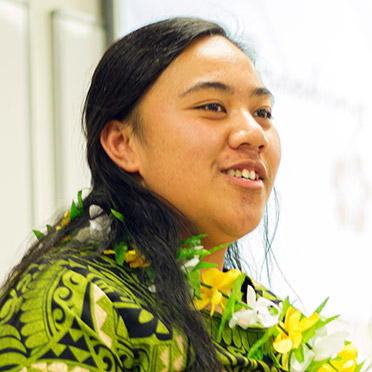
I've really enjoyed being part of the conversations we have in lectures or tutorials about why such health statistics exist and how we can use our skills to meet the needs of the communities we work with.
Rhonda Matagi Tomasi
BHealSc student
Related subject areas
Explore all subject areasHealthcare and medicine
Change lives with healthcare – become a medical professional or excel in lab tech, public health, and more
Health and biomedical sciences
Transform the world by learning from top researchers and shaping the future of healthcare, medicine, and the environment
Māori, Pacific and indigenous studies
Explore Māori, Pacific, and indigenous languages, heritage, and values to contribute positively to these communities
Sport and wellbeing
Study exercise science and nutrition to enhance physical and mental well-being and improve community health outcomes
Where Pacific knowledge meets global health challenges
Pacific and Global Health at Otago brings together passionate teachers, leading research, and strong connections across the Pacific region. You’ll learn from experts who work closely with Pacific communities, global health agencies and local organisations to tackle real issues in wellbeing and equity.
The programme is shaped by Pacific values and perspectives, giving you an authentic understanding of how culture and context influence health. You’ll study topics that matter right now – from climate change and migration to community health systems and policy.
With small classes and a collaborative approach, you’ll be supported to find your voice and build the skills to create lasting, positive change.
Programme details
Compare programmes for this subject.
| Level | Papers | Points |
|---|---|---|
| 100-level | HUBS 191 Human Body Systems 1 | 18 |
| HUBS 192 Human Body Systems 2 | 18 | |
| PUBH 192 Foundations of Epidemiology or POPH 192 Population Health | 18 | |
| 200-level | PACH 201 Pacific Health: New Zealand and the Pacific Region | 18 |
| PUBH 203 Health Policy and Politics | 18 | |
| PUBH 211 Epidemiology of Global Health Conditions | 18 | |
| MAOH 201 Hauora Māori in Practice: Working with Individuals and Whānau | 18 | |
|
At least two of BITC 201 Bioethics and the Life Sciences CMHC 211 Enabling Wellness and Ability I HIST 206 An Introduction to Pacific History PACI 201 Contemporary Pacific Island Issues POLS 213 New Zealand Foreign Policy PUBH 202 Health Promotion | 36 | |
| 300-level | PACH 301 Pacific Health: Advanced Applied Knowledge | 18 |
| PUBH 303 Public and Global Health: Current Issues | 18 | |
|
At least two of ANTH 323 Anthropology of Health BITC 301 Bioethics: Healthcare Issues and Global Perspectives CMHC 311 Enabling Wellness and Ability II MAOH 301 Hauora Māori in Practice: Working with Organistions and Communities PUBH 311 Public Health Research | 36 | |
| Plus | 126 further points | 126 |
| The following papers are suggested: ACCT 102, ASIA 101, BITC 101, BSNS 113, CMHC 201, ECON 112, GLBL 110, HIST 107 , MANT 101, PACI 103, STAT 115; ECON 201, ENGL 228, MANT 217, MANT 251 , PACI 210, SOCI 205, STAT 210; CMHC 301, ECON 306, HIST 337, PACI 301, PACI 310 , POLS 303, STAT 310 | ||
| Total | 360 |
A minor subject can be included in many of our undergraduate degrees. To earn a minor, you typically must complete a minimum of 90 points in that subject, with at least 18 points at the 300-level.
Your minor can be a subject more commonly taken for a different degree. For example, a BCom majoring in Marketing can include Japanese as a minor subject. To include this subject as a minor in your application, first find a major subject through our Subject Search or Study Match.
You can check what’s required to receive the minor accreditation in the programme details below.
Available as a minor subject for a Bachelor of Arts (BA), Bachelor of Music (MusB), Bachelor of Performing Arts (BPA), Bachelor of Theology (BTheol), Bachelor of Science (BSc), Bachelor of Commerce (BCom), Bachelor of Entrepreneurship (BEntr), Bachelor of Health Sciences (BHealSc), Bachelor of Arts and Commerce (BACom), Bachelor of Arts and Science (BASc) or Bachelor of Commerce and Science (BComSc) degree
| Level | Papers | Points |
|---|---|---|
| 100-level | POPH 192 Population Health or PUBH 192 Foundations of Epidemiology | 18 |
| 200-level | PACH 201 Pacific Health: New Zealand and the Pacific Region PUBH 203 Health Policy and Politics PUBH 211 Epidemiology of Global Health Conditions | 18 18 18 |
| 300-level | 18 | |
| Total | 90 |
Note: This minor subject is not available to students majoring in Community Health Care.
Papers
View a list of all related papers below.
More information
Have a question or need support? AskOtago can connect you with the right team for personalised help.
This information must be read subject to the statement on our Copyright & Disclaimer page.
Regulations on this page are taken from the 2026 Calendar and supplementary material.
Not sure what to study?
Take our short quiz to uncover study options matched to your background and interests.
Take the quiz