
We are currently recruiting healthy adults aged 20–29 years who live in Dunedin for the OFFSET Trial. This study will investigate whether a dietary fibre supplement can reduce short-term changes in after-meal glucose response and other cardiometabolic markers when participants eat commonly available processed foods.
Interested in participating in the OFFSET trial? Send the research team an email at OFFSET@otago.ac.nz
Who can join the study?
We aim to recruit 38 healthy adults aged 20–29 years who live in Dunedin during the study. You may be eligible if you:
- Have a body mass index between 18.5 and 27 kg/m².
- Usually eat a healthy diet.
- Usually eat three main meals each day, or are willing to follow a three-meal pattern during the study.
- Are willing to provide fasting blood samples, wear a continuous glucose monitor, and eat study-provided foods.
- Can use a compatible smartphone for the food diary app and complete online questionnaires.
Some medical conditions or medications, pregnancy or breastfeeding, regular use of tobacco or fibre supplements, dietary restrictions, or limited control over your usual food choices may affect eligibility. A screening questionnaire and blood test are also required. The research team will confirm eligibility before the intervention begins.
Why join the study?
You will contribute to research on whether dietary fibre supplementation can reduce short-term cardiometabolic changes when people eat more processed foods than usual. The study measures after-meal glucose response, blood markers, blood pressure, body weight, diet, physical activity, appetite, food-related thoughts, gastrointestinal symptoms, and adherence.
What happens if I join the study?
There are no study-related costs. The main study period will last at least 9 weeks and includes five in-person visits with the research team, taking about two hours in total, and some online activities. You will also complete an online follow-up about 8 weeks after your second intervention, bringing your total involvement to at least 17 weeks.
- Complete an online pre-screening questionnaire and attend five in-person visits, including a baseline visit.
- Complete baseline measurements at Visit 1 and repeat study measurements at the end of each intervention period (Visits 3 and 5).
- Wear a continuous glucose monitor during the two-week run-in and both two-week intervention periods.
- Complete a four-day food diary during the run-in and each intervention period. Each diary includes three weekdays and one weekend day.
- During both two-week intervention periods, eat the study foods you selected and take the assigned study product (dietary fibre or placebo). Mix one teaspoon into one cup of water and drink it three times daily, preferably with your main meals.
- Provide four fasting blood samples at Awanui Labs at Dunedin Hospital: one before and one at the end of each intervention period (Visits 2–5).
- Complete online questionnaires and attend an online follow-up about eight weeks after the second intervention.
At the end of each intervention period, you will be invited to take part in an individual interview of about 15 minutes about your experience.
|
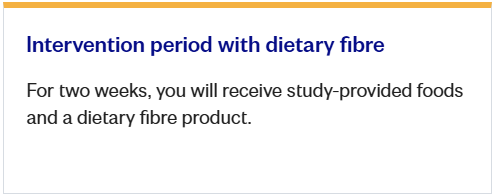
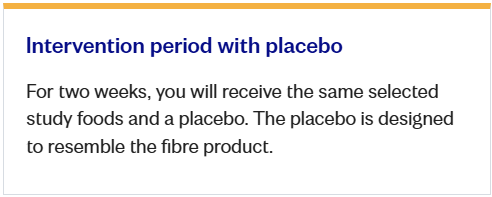
During both periods, mix one teaspoon of the study product into one cup of water and drink it three times a day, preferably with your main meals. Keep up your usual fluid intake.
Each participant completes both periods in random order. Neither you nor the research team will know which period contains the fibre product.
Research Study Timeline
| Study stage | What we ask you to do |
|---|---|
Pre-screening | Complete the online pre-screening questionnaire. The research team will review your initial eligibility and contact you about next steps. |
Visit 1Week 0 (30 minutes) | Complete study questionnaires and baseline measurements (height, body weight and blood pressure). Have a CGM sensor placed on your upper arm, then begin the two-week run-in and four-day food diary. |
Visit 2Week 2 (20 minutes) | Complete study questionnaires and measurements (body weight and blood pressure), and provide a fasting blood sample for eligibility checks. Remove the run-in CGM sensor and have a new CGM sensor placed on your upper arm. Once eligibility is confirmed, begin the first two-week intervention with your selected study foods and assigned study product, and start a four-day food diary. |
Visit 3Week 4 (30 minutes) | Complete study questionnaires and measurements (body weight and blood pressure), provide a fasting blood sample, and have the CGM sensor removed. You will be invited to take part in a semi-structured interview about your experience. |
WashoutWeeks 4–7 or later | Return to your usual eating pattern during the washout. You may choose a washout period of 3–6 weeks; Visit 4 will be scheduled accordingly. You will not wear a CGM during the washout. |
Visit 4Week 7 (10 minutes) | Complete study questionnaires and measurements (body weight and blood pressure), provide a fasting blood sample, and have a CGM sensor placed on your upper arm. Begin the second two-week intervention with the other study product and selected foods, and start another four-day food diary. |
Visit 5Week 9 (30 minutes) | Complete study questionnaires and measurements (body weight and blood pressure), provide a fasting blood sample, and have the CGM sensor removed. You will be invited to take part in a semi-structured interview about your experience. |
Follow-up8 weeks after visit 5 | Attend an online follow-up to check whether your eating pattern has returned to usual. |
Frequently asked questions
Tell me more about the study foods
You will choose foods from a list at baseline. The same selected foods will be provided during both intervention periods, with supplies arranged each week. You can collect the foods from a supermarket or arrange delivery. The research team will check midway through each period whether you need more food.
Do I need to eat only the foods provided by the study?
No. You do not need to eat only the foods provided by the study. However, eating the study foods you select during both two-week intervention periods is an important part of the study. You should aim to replace at least one-third of your usual food intake with study-provided foods. These foods are intended to replace some of the foods you would normally eat, where appropriate, or to be consumed as snacks.
What if I do not like some of the foods provided?
The research team will discuss the study food options with you before the intervention periods. The same selected foods will be provided during both intervention periods.
What equipment do I need to be part of this study?
You will need regular internet access, a compatible iOS or Android smartphone for the Easy Diet Diary app, and a device for online questionnaires. The research team will provide the study foods and products. You will wear a continuous glucose monitor during the run-in and intervention periods, but you will not need to operate it yourself.
What is a food diary?
A food diary records what you eat and drink. You will record four days during the run-in and each intervention period: three non-consecutive weekdays and one weekend day.
Where do I go to get a blood test?
Fasting blood samples will be collected by trained phlebotomists at Awanui Labs at Dunedin Hospital on four occasions. About 14 mL will be collected each time. The research team will provide appointment details.
Are there any costs or reimbursement?
There are no study-related costs. You will receive NZ$200 in supermarket vouchers in total for completing both two-week intervention periods.
Are there any possible discomforts?
The fibre product may cause mild, temporary stomach or bowel symptoms. A blood test may cause brief pain or bruising, and the glucose monitor may cause skin irritation. The study foods may be higher in salt, sugar or saturated fat than less processed foods. The participant information sheet explains the risks in more detail.
Participant information sheets
Taking part is voluntary. You can withdraw at any time without giving a reason. Please read the participant information sheets to find out more about the study.
- OFFSET Trial Participant Information Sheet (PDF)
- Blood Samples for Future Unspecified Research Information Sheet (PDF)
Email the research team to request the consent form and pre-screening questionnaire link.
Meet the research team
Sheila SkeaffProfessor, Department of Human Nutrition email: sheila.skeaff@otago.ac.nz | Claire CameronResearch Associate Professor, Biostastics Centre email: claire.cameron@otago.ac.nz |
Andrew ReynoldsResearch Associate Professor, Department of Medicine (Dunedin) email: andrew.reynolds@otago.ac.nz | Zichun (Aaron) HaoStudent, Department of Human Nutrition email: haozi277@student.otago.ac.nz |
This study is funded by the Riddet Institute, Centre of Research Excellence |
|
|---|
